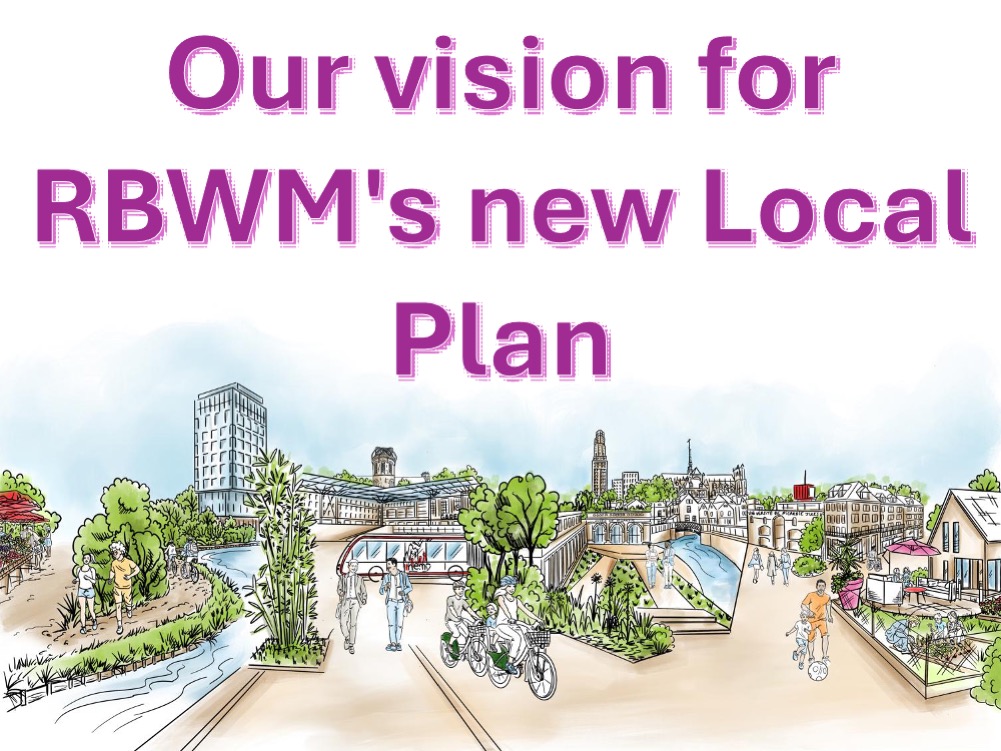
Planning for homes, nature, health, transport, resilience and prosperity together
RBWM is preparing a new Local Plan. The decisions made now could shape where people live, how they travel, the environment around them and the future prosperity of our Borough for decades.
As your local councillors, Carole and Wisdom Da Costa, we have submitted a detailed response setting out what we believe the Council should consider before making those decisions.
We recognise that new homes are needed. But the question should not simply be “Where can we fit the housing numbers?”
We think there is a much better question:
How can we meet people’s genuine housing and economic needs while creating a healthier, greener, better-connected, more resilient and prosperous Borough for everyone?
That means looking at the whole picture from the beginning.
Can we make better use of brownfield land, empty buildings and existing urban areas before consuming more undeveloped land?
Can we provide more genuinely affordable Social Rent homes?
Can new development help restore nature rather than simply minimise its loss?
Can we design homes, neighbourhoods and infrastructure capable of coping with future heatwaves, flooding and extreme weather?
Can excellent public transport, walking and cycling give people better alternatives to the car while reducing congestion and pollution?
Can we make sure schools, healthcare, water, sewerage, energy and other infrastructure are available when development occurs rather than trying to catch up afterwards?
And can economic growth create good jobs while helping us reduce carbon emissions, restore ecosystems and develop the industries and skills we will need in the future?
Our central argument is simple:
Housing, jobs, transport, schools, healthcare, nature, climate resilience and infrastructure should be planned together from the start—not considered separately after the major decisions about development have already been made.
Our full submission therefore sets out:
an overarching vision for the Borough; 15 areas we believe the Local Plan should address; and 17 specific requests to the Council.
It is deliberately ambitious. A Local Plan is one of the few opportunities we have to think about what kind of Borough we want to leave to our children and grandchildren and then use planning policy to help make that future possible.
👉🏾👉🏾👉🏾Click here to find out how you can respond easily.👈🏻👈🏻👈🏻
You can read our full submission below or click here to download our submission copy
FULL LOCAL PLAN SUBMISSION OF CLLRS DA COSTA
Overarching proposition
The new Local Plan should accommodate the Borough’s housing needs—including its identified need for genuinely affordable Social Rent homes—and economic needs through a regenerative and socially equitable spatial strategy that simultaneously reduces greenhouse-gas emissions towards net zero; restores, expands and reconnects ecosystems and nature; protects and improves public health; reduces air, noise and chemical pollution; and makes communities, buildings, infrastructure and ecosystems resilient to the reasonably foreseeable effects of climate change and extreme weather over their lifetimes.
It should enable sustainable economic growth and provide the zero-carbon transport, energy, water, social and green-blue infrastructure necessary to achieve these outcomes. These objectives should be determinants of the spatial strategy, development pattern, infrastructure strategy, site-selection process and development standards from the outset—not matters considered or mitigated only after development locations have been selected.
Housing delivery should consequently be assessed not simply by the number of dwellings provided, nor by the broad technical category of “affordable housing”, but by the extent to which the Plan meets evidenced housing needs by tenure—including Social Rent—and enables genuinely affordable living through lower housing, energy and transport costs and good access to employment, services, public transport, nature and healthy environments.
The Local Plan should plan for the climate of the future, not the climate of the past. Before selecting its preferred spatial strategy, RBWM should identify the reasonably foreseeable climate conditions and extreme-weather risks over the lifetimes of development and infrastructure and use these to determine where and how development occurs.
Finally, RBWM should establish measurable baselines, objectives, indicators and assessment criteria for these outcomes before selecting its preferred spatial strategy, and transparently assess reasonable spatial alternatives against them.
Executive Summary
The preparation of a new Local Plan is an opportunity to do more than determine how many homes should be built and identify land on which to accommodate them. It is an opportunity to establish a long-term spatial strategy for the kind of Royal Borough we want to create.
Our central proposition is that housing, employment, transport, infrastructure, public health, climate mitigation and adaptation, nature recovery and economic prosperity should be planned as an interconnected system from the outset. These considerations should help determine where development occurs and how places are designed, rather than principally being treated as consequences to mitigate after development locations have been selected.
We therefore ask RBWM to establish robust evidence of the Borough’s actual housing needs—including the need for Social Rent—and critically test the Government’s Local Housing Need figure; make the best use of existing buildings, brownfield land and urban capacity before determining the need for undeveloped land; and consider genuine affordability in terms of the combined costs of housing, energy and transport.
The spatial strategy should simultaneously seek to reduce whole-life carbon emissions; prepare communities, buildings and infrastructure for foreseeable flooding, extreme heat, drought and other climate risks; restore and reconnect nature; improve public health; reduce pollution; and make high-quality, progressively zero-carbon public transport, walking and cycling available to more residents. Schools, healthcare, transport, energy, water, wastewater, flood protection and green-blue infrastructure should be planned and appropriately phased alongside development rather than permanently trying to catch up with it.
These objectives need not be barriers to prosperity. We believe a healthier environment, genuinely affordable housing, better transport, resilient infrastructure and the growth of industries contributing to decarbonisation, resource efficiency, climate resilience and nature recovery can form part of a stronger and more sustainable local economy.
Most importantly, RBWM should establish the evidence, objectives, baselines and measurable assessment criteria before choosing its preferred spatial strategy. Reasonable alternatives should then be transparently compared against their housing, affordability, infrastructure, health, environmental, climate, transport and economic outcomes, with relevant expert organisations involved early enough for their evidence to influence those choices.
The purpose of our submission is therefore not to oppose necessary development, but to propose a better framework for deciding what development the Borough needs, where it should go and what it should achieve.
Our ambition can be summarised simply:
Meet the Borough’s genuine housing and economic needs while using the Local Plan to create a healthier, fairer, greener, better-connected, more resilient and prosperous Royal Borough for current and future generations.
15 areas the Local Plan should address
1. Establish a regenerative spatial strategy
The Local Plan should not begin simply with:
housing number → identify land → allocate sites → mitigate consequences.
It should begin with the outcomes the Borough needs to achieve and then determine which spatial pattern best delivers them.
Housing, employment, transport, climate, public health, ecosystems, water, infrastructure and social needs should therefore be treated as an interconnected system.
The preferred spatial strategy should be the reasonable alternative that best accommodates necessary growth while improving the Borough environmentally, socially and economically.
2. Meet actual housing need—including and especially Social Rent
RBWM should distinguish between total housing numbers and actual housing needs.
The evidence base should identify requirements by:
- tenure;
- household income;
- household size;
- age;
- disability/accessibility;
- family requirements;
- older people’s requirements;
- Social Rent need.
In particular, Social Rent should be separately identified and monitored, rather than disappearing inside the broad planning definition of “affordable housing”.
The objective should be to provide homes that people who need them can actually afford.
3. Establish a genuine affordability test
Affordability should not be assessed by housing cost alone.
For residents, the relevant economic burden is closer to:
Housing cost + energy cost + transport cost + unavoidable service charges = genuine cost of living in that home.
A nominally affordable home requiring two cars and substantial heating expenditure may be considerably less affordable in practice than a Social Rent home with excellent energy efficiency and public transport.
The Local Plan should therefore seek genuinely affordable living, not merely technically classified affordable housing.
4. Maximise existing urban and building capacity before consuming additional land
Before deciding how much undeveloped land is required, RBWM should establish the realistic capacity available from:
empty homes; vacant buildings; surplus offices; upper floors; town centres; brownfield sites; underused public estate; low-density commercial areas; appropriate infill; redevelopment; station-area intensification; surface car parks; and permitted-but-unbuilt sites.
This should become a comprehensive Urban Capacity and Building Reuse Assessment.
It should identify both total housing capacity and the potential contribution to Social Rent.
This should precede—not follow—the decision about major greenfield development.
5. Make whole-life carbon a determinant of the spatial strategy
Climate mitigation should not be reduced to requiring efficient new houses after sites have already been selected.
RBWM should establish a carbon baseline and assess the carbon consequences of alternative development patterns, including where practicable:
transport emissions + building operational emissions + embodied carbon + infrastructure carbon + land-use change + renewable-energy potential + sequestration.
A spatial strategy producing substantially fewer lifetime emissions should score correspondingly better.
The Local Plan should demonstrate how its overall development pattern contributes to the pathway towards net zero, rather than simply containing individual climate policies.
6. Make climate adaptation and protection of public health a primary spatial objective
This deserves comparable importance to carbon mitigation.
Development being planned today may remain occupied into the 22nd century. The Local Plan should therefore plan for reasonably foreseeable future climatic conditions, rather than simply historic weather.
RBWM should undertake a Climate Risk, Health and Resilience Assessment covering, as relevant:
Thames and tributary flooding; surface-water flooding; groundwater flooding; extreme rainfall; sewer exceedance; extreme heat and overheating; drought; water scarcity; storms/extreme winds; wildfire risk; and compound or cascading events such as flooding combined with power, transport or communications failure.
The assessment should consider both hazard and human vulnerability.
This should influence site selection before development is allocated.
7. Create climate-resilient, healthy buildings
Building policy should pursue three objectives simultaneously:
low carbon + climate resilience + human health.
The Local Plan should investigate the fullest lawful requirements concerning:
- high fabric efficiency;
- low-carbon heating;
- renewable energy;
- passive cooling;
- external shading;
- overheating prevention;
- ventilation;
- water efficiency;
- flood resilience;
- sustainable materials;
- embodied carbon;
- adaptability;
- energy storage/EV readiness.
Social Rent homes should receive the same high standards as market housing.
Homes should remain safe and comfortable during foreseeable extreme heat, flooding and other climate conditions without creating excessive future energy demand.
8. Establish a Borough-wide Nature Recovery Network
Nature recovery should not simply mean requiring each development to achieve the statutory minimum Biodiversity Net Gain.
The Local Plan should map and seek to restore a connected ecological system, incorporating:
protected habitats + ancient woodland + rivers + wetlands + floodplains + grasslands + hedgerows + ecological corridors + soils + urban green space + tree canopy + opportunities identified through the Berkshire LNRS.
The objective should be to:
protect → restore → expand → reconnect.
Development should strengthen rather than progressively fragment this network.
And this environmental improvement should benefit all communities, not particular housing tenures.
9. Integrate nature recovery with climate adaptation
Nature and adaptation should reinforce one another.
Green-blue infrastructure can simultaneously provide:
habitat + flood storage + cooling + carbon sequestration + water purification + recreation + public-health benefits.
RBWM should therefore investigate strategic:
wetlands; restored floodplains; river restoration; woodland; sustainable drainage; swales; rain gardens; ponds; permeable surfaces; green roofs; street trees; urban parks.
Particularly within the Thames catchment, development should be assessed for its effects on water movement and flood risk elsewhere—not merely whether an individual development can defend itself.
Green-blue infrastructure should be regarded as essential infrastructure, not landscaping left until the end of the design process.
10. Establish an urban cooling and heat-resilience strategy
Heat deserves explicit treatment because it poses a growing public-health risk and interacts strongly with urban design.
RBWM should map:
urban heat islands + tree-canopy deficiency + extensive hard surfaces + vulnerable populations + overheating buildings.
The Local Plan should establish a strategic cooling network involving:
trees + shade + parks + vegetation + green roofs/walls + appropriate water features + reduced hard surfacing + passive building design + shaded walking/cycling routes.
This should address existing urban areas as well as new development.
Trees and green space should consequently be regarded partly as public-health and climate infrastructure.
11. Make zero-carbon sustainable mobility available to everyone
Transport should be planned before or alongside development location, rather than attempting to solve traffic problems after development has been allocated.
The long-term objective should be an integrated network comprising:
rail/Elizabeth Line + rapid zero-emission transit + electric buses + demand-responsive transport + mobility hubs + walking + cycling, with integration between modes.
The objective is not to eliminate private transport. Cars and vans remain important for journeys for which they are the appropriate mode.
Rather:
high-quality public and active transport should make private-car ownership unnecessary for a much larger proportion of everyday journeys.
This network should serve all residents, irrespective of tenure or income.
12. Use transport policy to improve public health and ecosystems
Transport assessment should extend beyond congestion and CO₂.
Alternative spatial strategies should be assessed for effects on:
NO₂ + PM₂.₅ + non-exhaust tyre/brake particulates + noise + chemical road runoff + road casualties + physical activity + access to nature + habitat fragmentation.
Electrification removes much tailpipe pollution but does not eliminate tyre particles, road runoff, congestion or land consumption.
Therefore the objective should combine:
vehicle electrification + fewer unnecessary vehicle-kilometres + active travel + high-quality public transport.
That produces considerably larger health and ecological benefits.
13. Adopt infrastructure-first development
Major development should occur only where necessary infrastructure either exists or there is a credible, funded and appropriately phased means of providing it.
That includes:
public transport + schools + healthcare + electricity/grid capacity + water + wastewater + flood protection + digital infrastructure + green-blue infrastructure.
The Local Plan should identify:
what infrastructure is required → when → where → approximate cost → responsible provider → funding mechanism → relationship with development phasing.
Infrastructure should shape growth rather than permanently chase it.
14. Make economic growth regenerative and sustainable
The strategy should not present the environment and economy as opposites.
RBWM and the wider Thames Valley should continue supporting traditional economic strengths while developing new competitive advantages in:
clean energy; retrofit; energy management; low-carbon construction; circular economy; environmental monitoring; water technology; climate adaptation; ecological engineering; biodiversity measurement; nature restoration; environmental AI/data; nature finance.
Environmental challenges can themselves create industries, technologies, skills, employment and exportable expertise.
Social Rent also matters economically: businesses require workers who can afford to live within reasonable reach of employment.
Housing, transport and environmental quality are therefore components of economic infrastructure.
15. Establish social equity, transparent appraisal and measurable accountability
The benefits and burdens of development should be distributed fairly.
RBWM should avoid outcomes in which lower-income households disproportionately experience:
pollution + noise + flood risk + overheating + poor public transport + high energy costs + poor access to nature
while environmental improvements accrue disproportionately elsewhere.
Most importantly, before selecting the preferred spatial strategy, RBWM should publish the assessment framework by which reasonable alternatives will be compared.
It should include measurable indicators for matters such as:
housing/Social Rent + genuine affordability + whole-life carbon + transport accessibility + air pollution + noise + public health + climate risk + flood risk + nature recovery/connectivity + water + infrastructure requirements + economic outcomes.
This is what converts the preceding 14 areas from aspirations into decision-making criteria.
17 formal asks or requests to the Council
Ask 1 — Regenerative Local Plan objective
Make regenerative and socially equitable development an overarching objective of the Local Plan, integrating housing, economic prosperity, net zero, climate resilience, public health, nature recovery and infrastructure rather than treating these as separate or competing policy areas.
Ask 2 — Housing need and Social Rent
Undertake a robust assessment of housing need by tenure and household circumstances, separately quantify the need for Social Rent, and establish appropriate policies, targets and delivery mechanisms specifically for Social Rent rather than relying solely upon the aggregate category of “affordable housing”.
Ask 3 — Genuine affordability
Assess housing affordability in the context of the combined burden of housing, energy, transport and unavoidable service costs, and use the Local Plan to promote genuinely affordable living through appropriate tenure, location, energy performance and accessibility.
Ask 4 — Urban capacity first
Complete a comprehensive Urban Capacity and Building Reuse Assessment—including empty property, building reuse, brownfield land, town-centre regeneration, public land and appropriate urban intensification—before determining the requirement for development on undeveloped land.
Ask 5 — Carbon assessment
Establish a quantified carbon baseline and pathway towards net zero and assess the reasonably foreseeable whole-life carbon consequences of alternative spatial strategies, including transport, operational buildings, embodied carbon, infrastructure and land-use change.
Ask 6 — Climate Risk, Health and Resilience Assessment
Before selecting the preferred spatial strategy, undertake a Borough-wide Climate Risk, Health and Resilience Assessment covering foreseeable river, surface-water and groundwater flooding, extreme rainfall, heat and overheating, drought and water scarcity, storms and extreme winds, wildfire where relevant, and compound and cascading extreme-weather events over the expected lifetimes of development and infrastructure.
Ask 7 — Climate-resilient buildings
Use the fullest lawful extent of Local Plan powers to secure healthy, low-carbon and climate-resilient buildings, addressing energy performance, overheating, passive cooling, renewable energy, water efficiency, flood resilience, embodied carbon and adaptability, with equivalent standards across housing tenures.
Ask 8 — Nature Recovery Network
Establish a mapped Borough-wide Nature Recovery and Green-Blue Infrastructure Network, informed by the Berkshire LNRS and wider ecological evidence, before selecting development locations, with measurable objectives for protecting, restoring, expanding and reconnecting ecosystems.
Ask 9 — Nature-based climate adaptation
Treat green-blue infrastructure and nature-based solutions as essential strategic infrastructure for flood attenuation, urban cooling, water quality, carbon sequestration, biodiversity and public health, including catchment-scale consideration of development impacts within the Thames system.
Ask 10 — Urban cooling
Develop an Urban Heat and Cooling Strategy identifying current and future heat vulnerability and establishing measures including tree canopy, shade, green infrastructure, reduced hard surfacing and climate-responsive urban and building design for both existing and new communities.
Ask 11 — Comprehensive, Zero-carbon, mobility
Make access to integrated, useful, affordable and progressively zero-carbon public transport, walking and cycling a determinant of development location, density and mix, with sustainable mobility available to all communities and coordinated with the emerging Thames Valley SDS.
Ask 12 — Pollution and health
Assess reasonable spatial alternatives for their effects on public health and ecosystems, including air pollution, PM2.5, non-exhaust particulates, noise, chemical road runoff, physical activity, road safety, access to nature and habitat fragmentation—not merely traffic congestion and carbon emissions.
Ask 13 — Infrastructure first
Adopt an infrastructure-first approach under which the transport, energy, water, wastewater, health, education, digital and green-blue infrastructure necessary for growth is identified, funded and appropriately phased with development.
Ask 14 — Regenerative economic strategy
Develop an economic spatial strategy that supports existing economic strengths while actively enabling growth in industries and services contributing to decarbonisation, climate resilience, resource efficiency and ecosystem recovery, and recognise housing—including Social Rent—and sustainable transport as essential economic infrastructure.
Ask 15 — Transparent assessment and accountability
Before choosing the preferred spatial strategy or principal development locations, publish and consult upon the objectives, baselines, indicators, assumptions and assessment methodology by which reasonable spatial alternatives will be compared, and establish measurable Local Plan targets and monitoring arrangements for the principal environmental, social, housing, health, infrastructure and economic outcomes.
Ask 16 — Establish an independent evidence base for RBWM’s actual housing need and critically test the Local Housing Need figure
Undertake a robust, transparent and independently evidenced assessment of RBWM’s actual housing needs—including demographic change, household formation, migration, employment and labour-market requirements, affordability, existing housing stock, vacancy and under-occupation, housing by size and tenure, Social Rent and specialist housing needs—and compare the results with the Government’s standard-method Local Housing Need figure. The Council should identify and explain any material divergence between evidenced local need and the standard-method figure, examine whether any lawful basis exists for an alternative approach or different Local Plan housing requirement, and ensure that robust evidence is available to inform both the RBWM Local Plan and the emerging Thames Valley SDS.
Ask 17 — Establish early and continuing strategic participation by health, environmental, infrastructure and other expert bodies
RBWM should identify and secure early, continuing and meaningful participation by the organisations possessing the statutory responsibilities, specialist evidence, data and operational expertise necessary to develop the Local Plan. This should include, as relevant, the NHS and public-health bodies, Environment Agency, Natural England, water and wastewater providers, energy/network operators, transport authorities and operators, emergency services, education providers and other relevant environmental, infrastructure and community organisations. Engagement should begin during evidence gathering and development of reasonable spatial alternatives—not only after a preferred spatial strategy or proposed Local Plan has been produced.
The Council should publish which strategic bodies have been engaged, the evidence and advice sought and received, how that evidence has influenced the spatial alternatives and preferred strategy, and where the Council has departed materially from expert advice, its reasons for doing so.

