Executive Summary
RBWM’s new Local Plan could shape our Borough for the next 20 years. It also provides an important opportunity to rebuild public confidence following the difficulties and controversy surrounding the previous Local Plan—a lack of confidence that many community leaders tell us still persists.
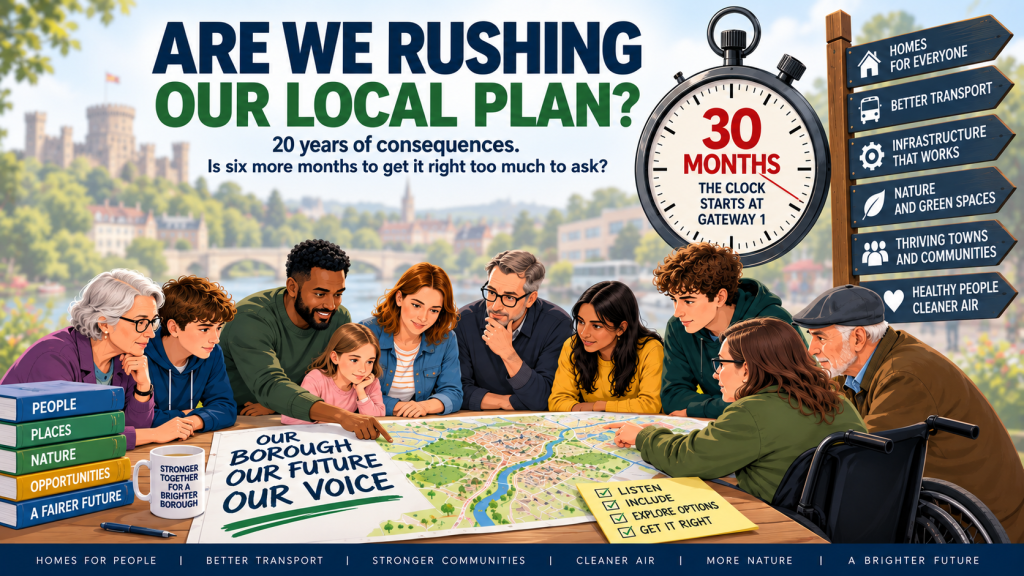
We support getting on with the work—but question whether the Council should trigger the statutory 30-month timetable this autumn when it appears to have until April 2027.
Those additional months could strengthen the evidence, explore genuinely different options, widen participation to residents missed by the recent consultation and better coordinate our Local Plan with the emerging Thames Valley Spatial Development Strategy (SDS).
There are also important questions about openness and democratic accountability. The Thames Valley strategy could affect nearly two million people and an economy approaching £100 billion, yet its statutory Strategic Planning Board has not been constituted and its membership and governance are still developing.
We therefore ask RBWM to continue the work intensively, but reconsider Gateway 1: strengthen the evidence, widen the conversation, demonstrate how residents’ views influence the plan, clarify the Thames Valley arrangements and ensure effective public and cross-party scrutiny.
Six months is a small price if it helps rebuild public confidence and get the next 20 years right.
A Local Plan could shape our Borough for decades. We need to get it right, not simply get it started quickly.
RBWM’s new Local Plan could determine where thousands of homes are built, how we travel, what infrastructure is provided, how our economy develops and what happens to our countryside and natural environment.
These decisions could shape our Borough for the next 20 years.
A good Local Plan could provide the homes people need while creating healthier communities, restoring nature, reducing pollution, preparing for climate change, improving public transport and supporting a prosperous local economy.
That is why we believe the Council needs to answer some fundamental questions before triggering the statutory 30-month Local Plan timetable.
1. How will the Council rebuild public confidence?
The previous Borough Local Plan was accompanied by substantial controversy over consultation, evidence, transparency and the extent to which residents could influence the outcome. Many community leaders have told us that the resulting loss of confidence has not disappeared. The new Local Plan therefore provides RBWM with an important opportunity not merely to produce a better plan, but to rebuild trust in how major decisions about our Borough are made.
That means public confidence should be treated as an objective of the plan-making process itself—not simply as a communications issue.
Whether or not the Council believes that distrust is justified, it cannot simply be ignored.
Trust will not be rebuilt by another questionnaire. Residents need to know:
What choices are genuinely still open?
How will our views be evaluated?
What will change because of what we say?
And, where the Council disagrees with us, will it explain why?
The Council should publish a transparent methodology showing how responses will be analysed, how alternative ideas will be considered and how residents’ contributions ultimately influence the plan.
2. Did everyone genuinely have an opportunity to participate?
Making a consultation available online is not the same as ensuring that everybody can participate.
What about older residents who rarely use the internet? People with disabilities? Young people? Busy working families? Residents whose first language is not English? People in communities that traditionally participate little in Council consultations?
Their Borough is being planned too. Their voices matter too.
For a plan potentially shaping every neighbourhood for 20 years, every household could have been directly informed.
A simple leaflet delivered to every home could have explained:
YOUR BOROUGH. YOUR FUTURE. YOUR SAY.
What is the Local Plan? Why does it matter? What decisions are genuinely open? How can you influence them?
Residents should have been able to participate online, by post, telephone or face-to-face.
But universal communication is only the beginning.
Inclusive consultation means actively going to people who might otherwise be missed—through schools and colleges, libraries, community centres, disability and older people’s organisations, housing associations, faith and cultural groups, businesses, GP surgeries, youth organisations, supermarkets, residents’ associations and community events.
For the next stage, RBWM should publish an Engagement and Inclusion Plan, identifying who it needs to reach, how it will reach them and how accessibility will be provided.
Afterwards, it should publish who actually participated, identify significant gaps and undertake corrective engagement where communities were under-represented.
The test should not simply be:
“Was everyone technically allowed to respond?”
It should be:
“Did we make a reasonable effort to hear from the whole Borough?”
3. Have we properly established what problems the Local Plan needs to solve?
Before deciding solutions, we need a proper understanding of the problems, opportunities and constraints.
The Council should establish and publish a comprehensive baseline covering housing needs and tenures; urban capacity and building reuse; infrastructure; transport; water, energy and wastewater; flooding, heat and climate risk; ecosystems and biodiversity; air pollution, noise and public health; and the economy we want in 20 years’ time.
Only when we understand the problems properly can we intelligently compare alternative solutions.
4. Is the Council starting the statutory process too quickly?
Once RBWM passes Gateway 1, the statutory 30-month Local Plan timetable begins.
The Council intends to do this in autumn 2026.
Yet the national timetable appears to allow RBWM until 30 April 2027.
Those additional months could be used intensively for research, evidence gathering, wider community engagement, developing alternative strategies and gaining greater clarity about the emerging Thames Valley Spatial Development Strategy.
There is an important distinction between delaying the work and delaying Gateway 1.
We are not asking RBWM to stop working.
We are asking:
Why trigger the statutory clock before we are genuinely ready?
5. Has a £108,474 Government grant influenced the timetable?
RBWM received £108,474 of additional Government funding linked to committing to an early start and passing Gateway 1 by the end of October.
Public money matters and should not be casually forfeited.
But should £108,474 determine when we trigger a Local Plan process capable of influencing potentially billions of pounds of development and the future of our Borough for decades?
The Council should ask Government whether the funding timetable can be varied if additional preparation would produce a better plan.
If there would be a financial consequence, publish it.
Councillors can then compare that figure with the potential benefits of additional preparation and make the decision transparently.
6. Is Gateway 1 really being treated as a readiness test?
Gateway 1 should represent genuine readiness, not merely a date in a project timetable.
The scoping consultation closed only weeks before RBWM’s proposed Gateway 1 date.
Can the Council genuinely analyse the responses, identify missing evidence, investigate new ideas, address shortcomings in engagement, develop alternative approaches and adjust its programme within that period?
And if the Gateway 1 date cannot change regardless of what the consultation reveals, how much influence can that consultation really have?
7. The Thames Valley strategic framework is still taking shape
Alongside RBWM’s Local Plan, a much larger Thames Valley Spatial Development Strategy (SDS) is emerging.
It is intended to deal with strategic issues crossing council boundaries, potentially including the scale and distribution of growth, strategic infrastructure, transport, economic development, climate resilience and nature recovery.
But the statutory Strategic Planning Board (SPB) that would be responsible for the SDS has not yet been formally established.
Even the arrangements leading towards that body are still evolving.
This matters because once operative, RBWM’s Local Plan will need to be in general conformity with the SDS.
This is not an argument for stopping Local Plan preparation until the SDS is complete. Parallel working is clearly envisaged.
It is an argument for using the preparation time available to reduce uncertainty before starting RBWM’s statutory 30-month clock.
8. Who actually comprises the emerging Thames Valley partnership?
This deserves much greater public attention.
The potential Thames Valley strategic planning geography encompasses councils across Berkshire, Oxfordshire and Swindon, with earlier proposals also referring to Buckinghamshire.
Across the wider area, the strategic planning exercise potentially concerns nearly two million residents and an economy worth approximately £97–98 billion GVA.
But that should not be confused with a settled statutory body.
At the time of writing, the picture is still developing. Authorities have been taking their own decisions about participation or involvement in the preparatory arrangements, while the statutory Strategic Planning Board itself has yet to be established.
That raises an obvious question:
How can we determine a strategy for the Thames Valley before we have finally determined who the Thames Valley strategic planning authority actually is?
For transparency, the Council should publish a simple table identifying:
every authority within the proposed SDS geography;
which have formally agreed to participate;
which are involved in an interim or co-opted capacity;
which have not yet committed;
which would have statutory membership of the eventual SPB;
and
the population and economic geography ultimately represented.
Residents should not have to piece this together from the committee papers of numerous councils.
NOTE
WHO IS INVOLVED IN THE THAMES VALLEY SDS?
Potential SDS authorities:
- Bracknell Forest Council (unitary authority, also acting as the accountable body for the partnership)
- Reading Borough Council (unitary authority)
- Slough Borough Council (unitary authority)
- West Berkshire Council (unitary authority)
- Royal Borough of Windsor & Maidenhead (unitary authority)
- Wokingham Borough Council (unitary authority)
- Oxfordshire County Council (upper-tier county council)
- Oxford City Council (lower-tier district)
- Cherwell District Council (lower-tier district)
- South Oxfordshire District Council (lower-tier district)
- Vale of White Horse District Council (lower-tier district)
- West Oxfordshire District Council (lower-tier district)
- Swindon Borough Council (unitary authority)
Authorities that have formally agreed involvement so far:
- Bracknell Forest Council (which acts as the accountable body for funds and hosts programme staff)
- The Royal Borough of Windsor and Maidenhead
- Slough Borough Council
- Reading Borough Council
- West Berkshire Council
- Oxfordshire councils (covering county, city, and district levels)
- Swindon Borough Council
Others within the potential geography:
- Cherwell District Council (lower-tier district)
- South Oxfordshire District Council (lower-tier district)
- Vale of White Horse District Council (lower-tier district)
- West Oxfordshire District Council (lower-tier district)
Status as at 15 September 2026. The statutory Strategic Planning Board has not yet been formally constituted.
If the geography, membership, representation and voting arrangements are not yet settled, who is currently authorised to make formative decisions for the emerging SDS—and how are those decisions being scrutinised?
9. Where are the openness, accountability and scrutiny?
The uncertainty over membership makes another concern even more important.
Substantial preparatory work is already underway before the statutory SPB exists.
That may be necessary.
But democratic safeguards should develop at the same pace as the strategy.
Residents and elected councillors should be able to answer:
Who is making decisions now?
Who represents RBWM?
When and where do they meet?
Where are agendas, reports, evidence, minutes and decisions published?
How much public money has been received and how is it being spent?
What decisions can be made before the statutory SPB exists?
Which decisions must return to elected councils?
How can opposition, independent and backbench councillors scrutinise the work?
How can residents and businesses influence the strategy before the major choices have been narrowed?
And ultimately:
Who is democratically accountable for the decisions being developed on behalf of communities across the Thames Valley?
A strategic planning process should not become less transparent because it crosses council boundaries. It should become more transparent.
10. One Thames Valley public information portal
There is a straightforward solution to much of this.
Create a single Thames Valley SDS public portal.
It should publish:
participating and potential authorities;
representatives and governance arrangements;
meetings, agendas, reports and minutes;
decisions and delegated authorities;
Government funding, budgets and expenditure;
commissioned research and the emerging evidence base;
timetables and milestones;
consultations;
and
opportunities for residents, businesses and councillors to participate.
Residents should be able to follow the development of the SDS from beginning to end without searching numerous council websites.
11. Are we risking duplication and reworking?
RBWM’s Local Plan and the Thames Valley SDS are progressing at broadly the same time.
Both may require substantial evidence concerning housing, transport, infrastructure, economy, water, climate and the environment.
Some evidence belongs at Borough level. Other strategic evidence may be better produced once across the Thames Valley.
There is also a risk that assumptions developed locally may subsequently require reconsideration because of the SDS.
The Council should identify what evidence should be produced locally, what should be shared and what properly belongs at SDS level.
12. Have we explored genuinely different futures?
A scoping exercise should be an opportunity to think broadly.
We should be asking:
What sort of Borough do we want to create?
Could different strategies emphasise urban regeneration and building reuse; brownfield development; excellent public transport; nature recovery; healthier neighbourhoods; climate resilience; stronger town centres; or combinations of these?
Residents should be invited not merely to comment upon Council propositions but to suggest fundamentally different approaches.
13. Could development actually make our Borough better?
The Local Plan should not simply answer:
“Where can we put the required houses?”
A more ambitious question is:
“How can the development we need help create a substantially better place?”
Could we simultaneously provide appropriate and affordable homes, better public transport, stronger infrastructure, cleaner air, healthier communities, thriving town centres, restored ecosystems, greater climate resilience and sustainable economic growth?
These should help determine our spatial strategy—not be considered only after development locations have been selected.
Our call to the Council
We support good planning. That is precisely why we should not rush this.
We ask RBWM to:
1. Continue Local Plan preparation intensively—but reconsider the autumn Gateway 1 date.
2. Ask Government whether the £108,474 funding timetable can be varied, and publish the answer and any financial consequences.
3. Publish a genuine Gateway 1 readiness assessment before starting the statutory clock.
4. Publish an Engagement and Inclusion Plan for the next consultation, including direct household communication and online, postal, telephone and face-to-face participation.
5. Tell us who was reached and who was missed, and undertake corrective engagement where communities were under-represented.
6. Show residents what changed because they participated—what was heard, what was accepted or rejected and why.
7. Explain clearly how the RBWM Local Plan will interact with the Thames Valley SDS.
8. Publish exactly who is involved in the emerging Thames Valley arrangements, distinguishing the potential geography, current participants, interim/co-opted partners and eventual statutory SPB membership.
9. Demand openness, accountability and effective cross-party scrutiny of the Thames Valley SDS, including public meetings and papers, transparent finances and evidence, meaningful public participation and scrutiny throughout its development.
10. Establish a single public-facing Thames Valley SDS portal so residents can see who is involved, what is being considered, who decided what and how they can participate.
11. Avoid unnecessary duplication between RBWM and Thames Valley evidence gathering.
12. Put the future quality of the Borough at the heart of the Local Plan, assessing alternatives transparently against housing, affordability, infrastructure, prosperity, accessibility, public health, pollution, carbon, climate resilience, nature and quality of life.
Getting it right matters more than getting it started quickly
Six months is tiny compared with the lifetime of the communities we are creating.
If additional preparation produces stronger evidence, genuine alternatives, wider participation, better strategic coordination and greater public confidence, those months could prove enormously valuable.
And the same principle applies to the emerging Thames Valley strategy.
Before decisions affecting nearly two million people and an economy approaching £100 billion are developed, we should know who is making them, under what authority, using what evidence and subject to what democratic scrutiny.
Planning is not only about reaching the right answer.
The process by which we reach it must deserve public confidence too.
Continue the work. Strengthen the evidence. Widen the conversation. Include everyone. Clarify the SDS. Open it to scrutiny. Then start the statutory clock when we are genuinely ready.
Note: The main image is AI generated and meant to be figurative of the issues set out in this article.

