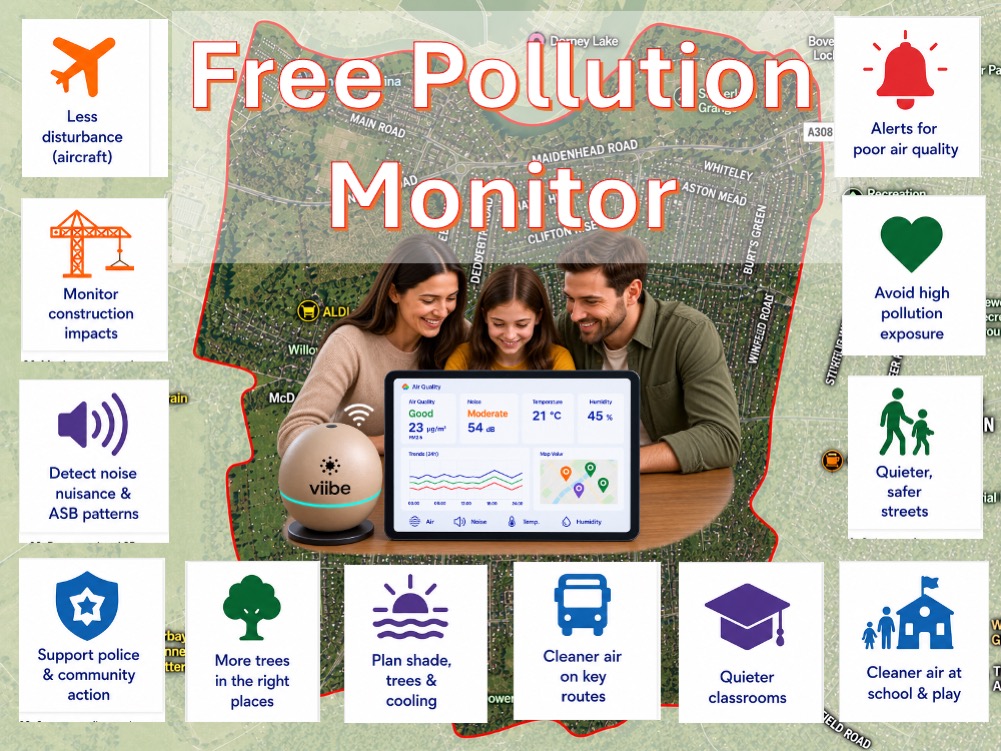
In our September 2026 newsletter, Carole and I highlighted an exciting opportunity for residents to help us understand—and ultimately improve—the environment in which we live.
West Windsor is one of a small number of areas taking part in a community study with UK environmental monitoring company Viibe.
Over six months, small smart sensors hosted in residents’ windows and at local schools will continuously monitor our local environment. The aim is to create something we have never had before: a detailed, real-time picture of conditions across our community, street by street.
And we would like residents across the Clewer & Dedworth West Ward to join us.
- Resident sign-up – https://tally.so/r/KY4kZX
- School sign-up – https://tally.so/r/XxpJZ4
What will be measured?
The Viibe sensors monitor important aspects of our environment, including PM1, PM2.5 and PM10 particulate pollution, nitrogen dioxide (NO₂), ozone (O₃), sound, temperature and humidity.
Residents hosting a monitor will be able to access a live dashboard, allowing them to see readings from their own sensor and across the wider study area.
But collecting data isn’t the objective.
The real opportunity is what residents, families and our community can do with it.
From me and my family to our whole community
We see the potential benefits as a series of widening circles.
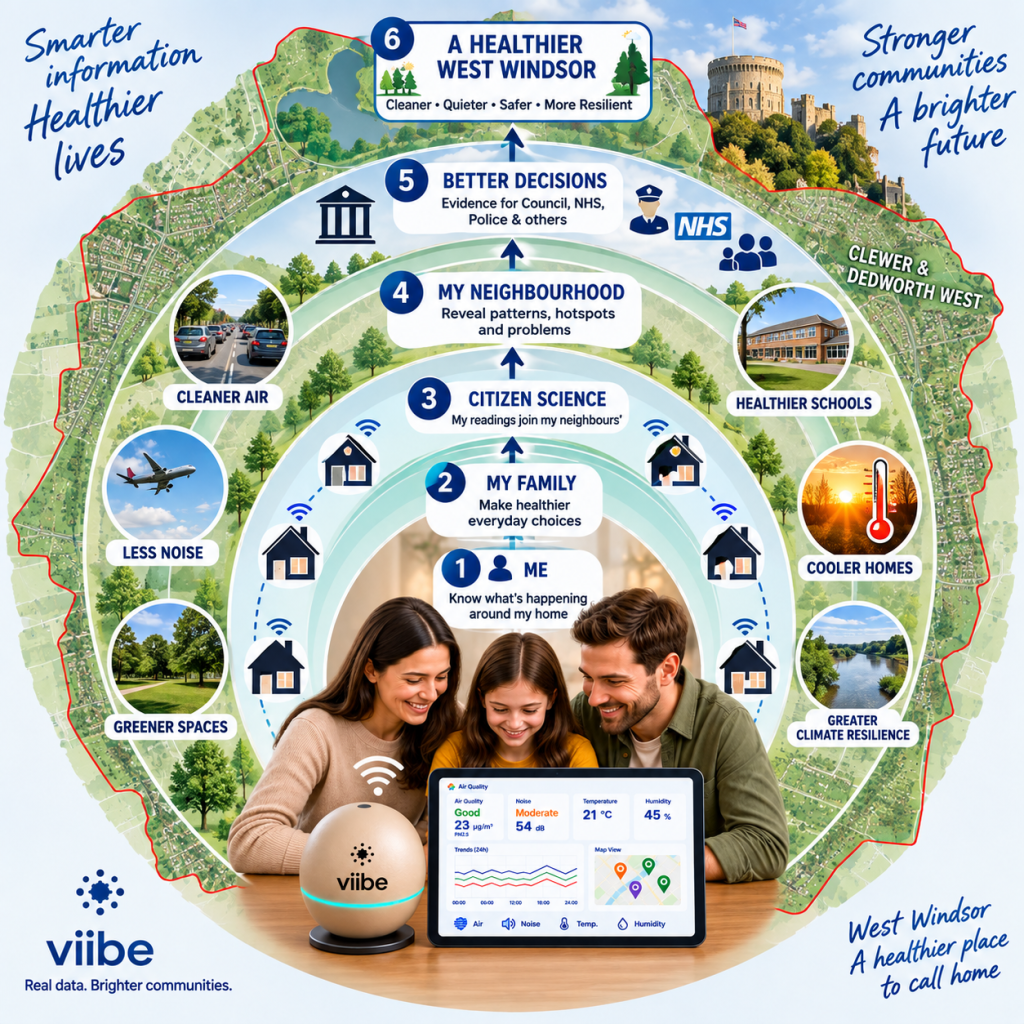
1. ME — understand the environment around you
For the first time, participating residents could begin to understand what is happening immediately outside their own home.
When is air pollution highest? When is it lowest? How hot does it become? When does noise peak?
Instead of relying solely on measurements taken elsewhere, you have information from your own window and your own street.
2. MY FAMILY — use information to make healthier choices
Over time, those readings could help families modify everyday behaviour to reduce their exposure.
You might discover that pollution is consistently lower at particular times and choose then to walk, exercise or take children outside. You may find that one route has better air than another, or learn when it is best to ventilate your home.
Temperature readings could help households understand when their homes are overheating and experiment with ventilation, shading, curtains and other cooling measures.
Residents could also keep a simple diary comparing environmental conditions with symptoms such as coughing, wheezing, headaches, disturbed sleep or breathing difficulties.
For someone already monitoring a condition such as asthma, environmental readings could potentially be considered alongside their normal symptom or peak-flow records.
A Viibe monitor cannot diagnose a medical condition, and a correlation cannot establish that pollution or noise caused a symptom. But repeated patterns could provide useful contextual information for a resident to discuss with their GP, nurse or other healthcare professional.
That turns environmental monitoring into something immediately practical:
Measure → understand → change behaviour → measure again → learn.
3. CITIZEN SCIENCE — your sensor becomes part of something much bigger
This is where something quite exciting happens.
One monitor tells us what is happening at one house.
Dozens of monitors distributed across our community begin to tell us what is happening to West Windsor.
Residents and schools effectively become citizen scientists, helping create a shared body of evidence about the place in which we live.
And because participants can compare their readings with the wider network, we may begin to distinguish between something happening at one property, something affecting one street, and something occurring across a much larger area.
AI analysis can then help identify correlations, recurring patterns and unusual events within what could eventually become millions of individual environmental measurements.
The more streets represented, the richer that evidence becomes.
4. MY NEIGHBOURHOOD — discover problems we cannot currently see
A dense network could start answering questions which occasional or distant monitoring cannot easily answer.
Are there particular pollution hotspots?
What happens around schools at drop-off and collection times?
Are some walking routes cleaner than others?
Can we see the environmental effects of congestion?
What happens when construction activity starts?
Where are the hottest parts of our neighbourhood during extreme heat?
How significant are different sources of noise at different times?
Most importantly, we shouldn’t prejudge the answers.
Good citizen science may confirm things we already suspect—but it may also show that some of our assumptions are wrong or reveal patterns nobody had previously noticed.
5. BETTER PUBLIC SERVICES — turn evidence into action
This is where individual monitors potentially become a powerful community resource.
The study envisages information helping residents and community representatives engage with RBWM, the Police, NHS and other organisations.
Evidence could help inform decisions about traffic and highways, public health, schools, planning, construction, noise, community safety, trees and green infrastructure, and climate adaptation.
Instead of saying:
“We think there is a problem here.”
we may increasingly be able to say:
“Here is what residents are actually experiencing, where it is happening, when it is happening and how frequently.”
That is potentially a very different conversation.
6. A HEALTHIER, SAFER AND MORE RESILIENT WEST WINDSOR
Perhaps the greatest opportunity is to close the loop.
If evidence identifies a problem and an intervention follows, the monitoring network could potentially help us determine whether that intervention actually worked.
Plant trees or introduce shade → did temperatures fall?
Change traffic arrangements → did pollution or noise change?
Introduce measures around a school → did children’s environmental conditions improve?
Address a recurring nuisance → did the problem disappear?
That creates a much better model for local decision-making:
Measure → Understand → Intervene → Measure again → Learn
Rather than policies being judged principally by whether something was done, we can increasingly ask whether it produced the outcome residents actually needed.
Why West Windsor?
Clewer & Dedworth West provides a particularly interesting location for the study.
We have a substantial residential community alongside green spaces and a nature reserve; four primary schools; busy roads; significant development on our western edge; and we sit directly beneath Heathrow flight paths.
That means homes, schools, transport, development, nature, pollution, noise and climate pressures all interact within a relatively compact area.
A sufficiently dense monitoring network gives us an opportunity to understand those interactions far better.
What does hosting a monitor involve?
Very little.
Participation is completely free. Viibe supplies, installs, maintains and eventually removes the equipment. Installation takes only minutes.
You simply need a suitable window, power socket and Wi-Fi connection, and participants can withdraw at any time.
Registering your interest takes less than a minute and does not commit you to having a monitor installed. Viibe will provide further information and obtain consent before anything is installed.
Will you become one of West Windsor’s citizen scientists?
Carole and I would love to see monitors distributed across as many parts of Clewer & Dedworth West as possible.
Because every additional household potentially fills another gap in our understanding.
Your monitor can help you understand the environment around your own home.
Your readings can help your family make better-informed choices.
And together, our data could help us make the case for better interventions, better public services, better health and a healthier, safer and more resilient West Windsor.
Register your interest in the Viibe study
- Resident sign-up – https://tally.so/r/KY4kZX
- School sign-up – https://tally.so/r/XxpJZ4
It takes under a minute, costs nothing and commits you to nothing.