
Summary
- Care experience does not disappear with age. The boys placed in Maidenhead’s Green Field House are now older men, and survivors are still seeking answers. Our work on their behalf continues.
- Cllr Carole Da Costa’s motion, seconded by Cllr Jack Douglas, sought to turn recognition into a practical commitment: listening to care-experienced people of all ages and seeking early negotiated resolution of legal disputes where appropriate and lawful.
- Its listening principles reflected both LGA guidance and RBWM’s own Corporate Parenting Strategy. The young people who helped shape that strategy welcomed progress but also asked for honest conversations about what was not working and improvements they could experience. The motion brought that emphasis on listening and responding to a wider group, including older survivors.
- Amendments proposed by Cllr Amy Tisi and supported by Council Leader Simon Werner shifted the emphasis towards endorsing existing practice. In my view, that sat uneasily with the strategy’s commitment to identify shortcomings and make changes. Carole withdrew the motion because the substantive changes undermined its purpose.
- We will keep pressing for dignity, answers and fair treatment. The question remains: where must the Council do better, and what will it change?
Introduction
What does a council’s commitment to care-experienced people mean when their childhood was decades ago?
That was the question at the heart of the motion proposed by Cllr Carole Da Costa and seconded by Cllr Jack Douglas at RBWM’s Full Council meeting on 22 September 2026.
A previous newspaper report (Maidenhead Advertiser 20 August 2026) focused on concerns raised by young people leaving Frogmore Court. Those concerns mattered. But the motion had a wider purpose: how the Council listens to and treats care-experienced people throughout their lives, including older survivors of abuse.
Understanding that distinction helps explain both the motion and Carole’s decision to withdraw it after substantial amendments.
A responsibility that reaches across generations
Green Field House in Maidenhead was a boys’ children’s home run by Berkshire County Council, a predecessor authority to RBWM, during the 1960s and early 1970s.
The Council’s correspondence with government describes allegations of systematic sexual abuse and exploitation. It asks who knew what was happening, when they knew, and why the children were not protected.
Those boys are now older men. Some have spent decades seeking answers. Their childhood experience of care—and its consequences—did not disappear when they became adults.
In February 2025, the Council Leader and leaders of other political groups (including myself) wrote to the Home Secretary seeking a public inquiry into Green Field House. Jess Phillips replied in April that the Home Office would not commission that inquiry, while identifying possible routes for locally led work.
In September 2025, Cllrs Simon Werner, Amy Tisi and Carole Da Costa signed a further letter to the Prime Minister. They asked for the boys’ experiences to be included in the proposed national statutory inquiry into group-based child sexual exploitation and abuse, and for a public inquiry to be held.
That letter reported that two more survivors had died since the national inquiry was announced. Time matters when people have already waited so long.
The minister’s October 2025 response said that the inquiry’s appointed chair would determine the specific areas for review. It did not confirm Green Field House’s inclusion.
These were cross-party efforts to secure recognition and answers. They also raise a question closer to home: how should the Council itself respond to people whose experience of care still shapes their lives?
Our work with Government and even the Church of England on behalf of these boys, now men, continues.
Why Carole brought the motion
Carole has spoken publicly about her own experience of residential care as a teenager. During the earlier Council debate supporting an inquiry into Green Field House, she described being placed in a children’s home for safety and experiencing physical, emotional and sexual abuse there.
She spoke about the importance of acknowledging survivors’ experiences and hearing people who had felt voiceless.
Her advocacy through the West Windsor Hub and her former role as Vice Chair of RBWM’s Corporate Parenting Forum provide further context for her interest in these issues.
At that earlier Council meeting, Cllr Tisi thanked Carole for speaking openly. She also recognised that the Council’s commitment to care-experienced people extended beyond their time in care or their period as recent care leavers, “for the rest of their life”.
The September motion sought to turn that wider principle into a practical commitment.
What the motion actually proposed
In July 2024, RBWM agreed to treat care experience as a protected characteristic. This was a commitment governing the Council’s own approach; a local resolution does not itself amend the Equality Act.
Carole’s motion sought to reaffirm that decision, strengthen listening to care-experienced people and establish an approach to resolving legal disputes.
Following extensive discussion with the Deputy Monitoring Officer, the wording of the motion was cleared for submission to Full Council. That clearance concerned the motion’s wording and its submission for debate.
The motion said:
This Council:
i) Reaffirms its decision from July 2024, that care experience be considered as a protected characteristic.
ii) Reaffirms a desire for the council and its partners to actively seek out and listen to the voices of care-experienced people when developing new policies.
iii) Resolves, consistent with (i) and (ii), that in any legal proceedings between the Council and a care-experienced person, the Council will seek early negotiated resolution wherever appropriate and lawful, having regard to the circumstances of each case, and requests that the proper officer ensure this approach is applied.
The third clause was carefully qualified. It did not require the Council to admit liability, concede every claim or settle regardless of cost. It asked the Council to seek early negotiated resolution where appropriate and lawful, considering each case’s circumstances.
Early negotiation can offer an opportunity to resolve a dispute fairly while limiting its financial and personal costs. Sometimes agreement will not be possible, and proceedings will continue. The proposal allowed for that.
The motion named no individual and sought no determination of any live case. In seconding it, Jack expressly avoided discussing the merits of an individual case. He addressed the broader position of people living with the consequences of abuse in homes run by the predecessor authority.
The question was one of policy: should the Council make an explicit commitment to consider early negotiated resolution when it is in a legal dispute with a care-experienced person?
Why the amendment changed its meaning
Cllr Tisi proposed an amendment during the debate, supported by Council Leader Cllr Werner.
It retained the expression “care-experienced people”. However, it changed the motion from a commitment to act into an affirmation of existing practice.
The differences can be seen in three places:
| Original motion | Amendment |
| Reaffirms a “desire” to seek out and listen to care-experienced people | Reaffirms the Council’s existing “approach” |
| “Resolves” to seek early negotiated resolution where appropriate and lawful | “Reaffirms” that the Council will do so |
| Requests that the proper officer “ensure” the approach is applied | Requests that the officer “continues to ensure” it |
Cllr Tisi argued that the Council already undertook the activities described. In introducing the amendment, she referred to achievements in corporate parenting, the annual report, Ofsted’s care-leaver judgement and a subsequent monitoring visit.
Those achievements deserve recognition. But the examples discussed centred on children and young care leavers. They did not, by themselves, establish how the Council’s approach operated for older care-experienced adults, particularly in legal disputes.
There is a meaningful difference between resolving to apply an approach and declaring that it is already being applied. The latter invites a straightforward question: what evidence demonstrates that existing practice?
An officer’s authority to settle proceedings is also different from an explicit policy of seeking early negotiated resolution with care-experienced people.
In my view, the amendments sat uneasily with the Council’s own Corporate Parenting Strategy. That strategy recognises achievements while promising to identify what needs to improve and turn people’s experiences into meaningful change. Kickback’s young people ask for the same approach: honest conversations about what is not working, followed by improvements. Recasting the motion as an endorsement of existing practice left that essential question unanswered: where does the Council need to do better, and what will it change?
Cllr Werner described the amendment as “stronger, more truthful”. Carole disagreed, explaining that it did not ask for action in the same way as her original motion.
The amendment passed by 18 votes to 10, with two abstentions. Carole then withdrew the motion, with Jack’s agreement, because the substantive changes meant it no longer expressed the commitment she had brought forward.
The amended motion was therefore not subsequently adopted as a final resolution.
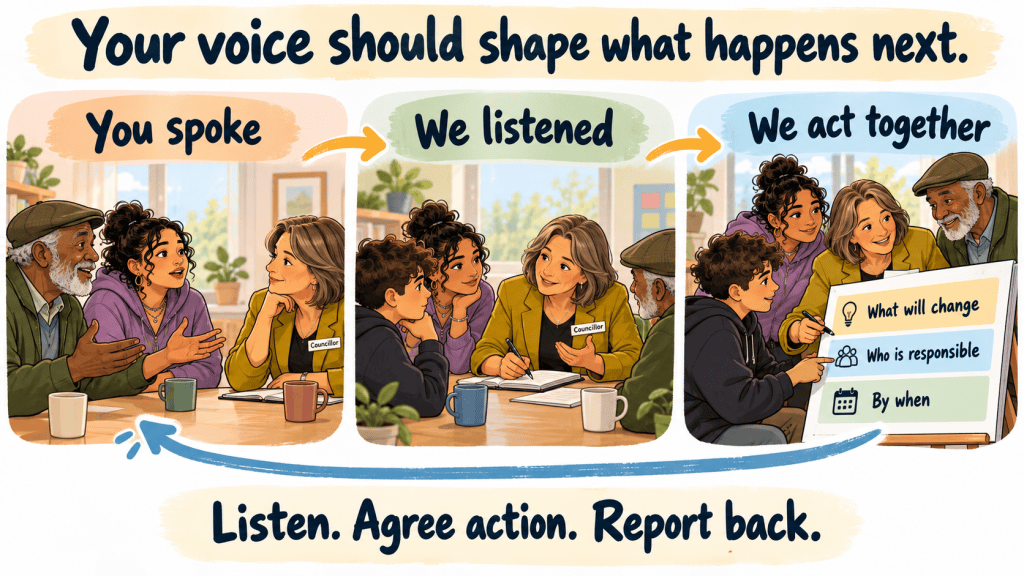
Listening must lead somewhere
The Local Government Association’s Listening and engaging with care experienced individuals: A good practice guide provides a useful framework for considering the motion’s wider purpose.
It expressly includes care-experienced adults and recognises their expertise in their own lives. Its participation framework connects opportunities to speak with an audience, influence and feedback. The guide uses the heading “No voice without action”, while explaining that meaningful engagement does not require councils to accept every suggested change. It requires serious consideration of what people say and whether policy or practice should change.
That supports the principle behind the motion’s listening clause. People whose time in care was decades ago should have opportunities to inform the Council’s policies, alongside children in care and younger care leavers.
Participation should also have a visible outcome: an explanation of what was considered, what will happen and why a particular course was chosen.
The LGA guide does not prescribe Carole’s proposal for early negotiated resolution. That was a policy choice she asked Council to make, with safeguards. Its guidance nevertheless helps explain why listening should have practical consequences.
Looking beyond performance reports
On 2 October, after the Council debate, RBWM’s Councillor Snapshot (an email sent by RBWM’s Democratic Service officers to Councillors each week) encouraged members to read another LGA resource: Scrutiny informed by the voices of children and young people.
The resource explains how direct experience helps councillors understand the effects of decisions and services. It can reveal issues that figures alone do not show and help members identify both strengths and areas for improvement.
Its focus is children and young people, whereas Carole’s motion extended to care-experienced people of all ages. The two resources therefore serve different but complementary purposes.
Full Council and scrutiny committees also have different functions. Nevertheless, the underlying lesson is relevant across the Council: service reports and personal experiences each contribute to understanding whether policies work.
An outstanding inspection judgement is an achievement. It cannot answer every question about an individual’s experience or establish how a policy operates for people outside the service being assessed.
Distinct experiences, a shared principle
At the September meeting, a recent care leaver spoke during public questions about having to leave Frogmore Court where she had been placed by RBWM. She described residents feeling blindsided and losing trust in the Council as corporate parent.
Her questions concerned current circumstances. The older survivors associated with Green Field House face different questions, rooted in events many decades ago. Their experiences should be understood individually.
A shared principle connects them: people with experience of care should be able to raise concerns, influence policies and receive a considered response.
There is much valuable work by staff, carers and personal advisers to recognise. Listening to difficult experiences can help build on that work and identify where change is needed.
What should happen next?
The withdrawal of the motion leaves its underlying policy questions unanswered.
The Council could now explain:
- How older care-experienced adults are included in its listening, engagement and policy work.
- What its existing approach to early negotiation is, and how that approach is considered in disputes involving care-experienced people.
- How listening influences decisions, including how people receive feedback when their proposals cannot be followed.
- How it evaluates the practical effects of its commitment to recognise care experience.
These questions can be addressed without disclosing private information or discussing the merits of individual legal proceedings.
They are also an opportunity to build on the cross-party commitment shown in seeking answers for Green Field House survivors.
For some people, care experience belongs to the recent past. For others, it began more than half a century ago.
All deserve dignity, compassion and a fair hearing. Recognising care experience should make a visible difference to how the Council treats people throughout their lives.
Cllr Wisdom Da Costa
Independent, Clewer & Dedworth West
Leader, Independent Alliance Group, RBWM
Note: The images are AI-generated and meant to be figurative of the issues set out in this article and a way forward to do better for residents.

