Executive summary
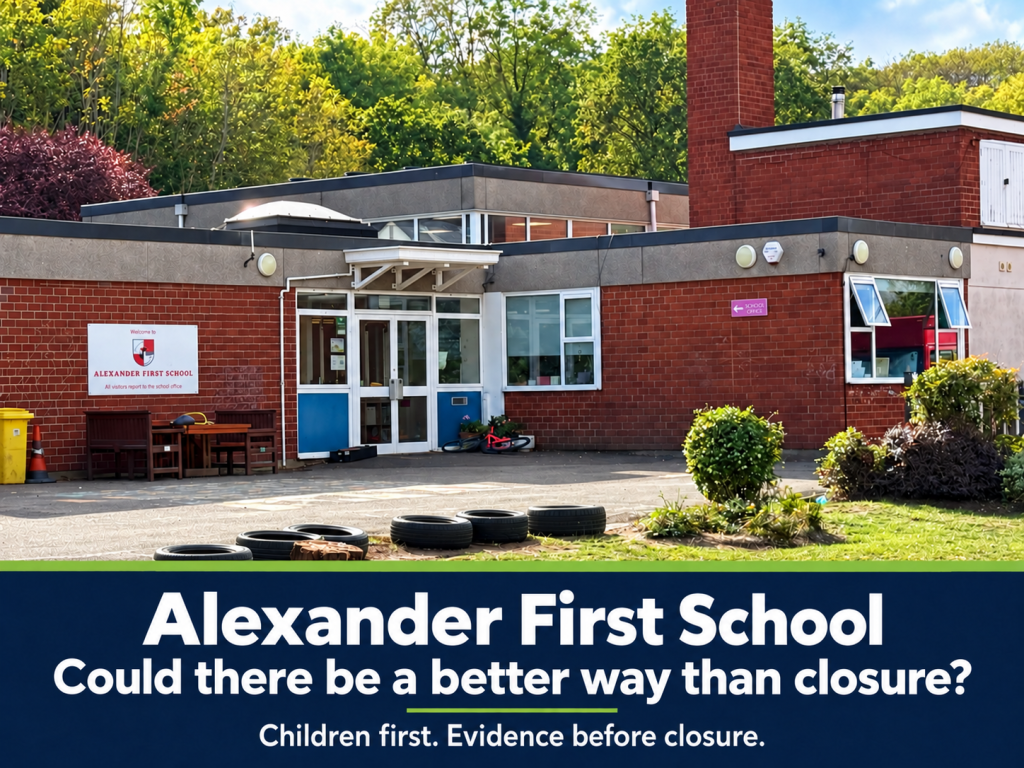
Alexander First School’s closure is proposed—not decided. As your ward councillors, We are asking whether there is a better, sustainable option for children and our community.
- Check the demand: show exactly how nearby new homes, including AL21, and military-family numbers have been counted.
- Test alternatives: compare closure with a smaller mainstream school, shared leadership and a funded SEN unit or resourced provision, drawing on South Ascot Village’s example.
- Check whether military-family demand could recover: verify whether recent military movements have temporarily reduced pupil numbers, and whether future family occupancy at Broom Farm could change the case for closure.
- Understand parental choices: investigate why families choose other schools and whether improvement could rebuild confidence.
- Explain the finances: distinguish annual savings from accumulated deficits and include the full costs of each option.
- Protect children and staff: demonstrate suitable placements and support, while maintaining the school’s stability during the process.
- Keep consultation open: publish the evidence and costed alternatives so residents can influence the outcome.
We intend to attend Cabinet on 20 October to raise key questions. The blog sets out our full questions to the council.
Story
Alexander First School is part of the community that Carole and I represent. Its proposed closure matters deeply to children, parents, staff and the Broom Farm families who depend on it.
We are asking the council for the evidence behind its recommendation, a fair comparison of alternatives, and a plan to protect children while the decision remains open.
We intend to attend Cabinet on 20 October and register beforehand to raise key questions. I will also seek detailed written answers to the full list below, so families and school staff can see exactly what I am asking.
Cabinet is due to consider consultation on 20 October. Closure has not been approved. The proposal would end mainstream schooling at Alexander after the 2027/28 academic year. [1]
There is a real problem to address. Falling demand can leave schools struggling to fund their staff and services. But demonstrating that Windsor needs fewer places does not automatically demonstrate that Alexander should close.
Nearby new homes make the forecasts particularly important. AL21’s adopted allocation provides for approximately 450 homes. [2] The school forecasts include housing growth, but the published commentary does not identify AL21 separately. [3] Residents deserve to see which homes have been counted, when occupation is expected and how many children are expected to need places at each school.
There is another important question about future demand. Cllr Neil Knowles, the council’s Armed Forces Champion, has raised the possibility that recent military movements have contributed to lower pupil numbers at Alexander. This needs verification with the Ministry of Defence: a temporary reduction in military-family occupancy is different from a lasting fall in demand. I am asking whether the forecasts reflect anticipated family numbers at Broom Farm, what would happen if occupancy recovered, and whether that could change the case for closure.
We should also test the alternatives properly. Could a smaller Alexander, with reorganised classes and shared leadership, be sustainable? Could Alexander remain a mainstream school with a formally commissioned SEN unit or resourced provision? Could phased admissions reductions elsewhere achieve a better outcome?
These options need willing partners, suitable premises and sound finances. They should be costed together, rather than dismissed through general assurances.
South Ascot Village Primary provides a concrete local example: it remains a mainstream school with an SEN unit, called The Canopy, and operates mixed-year classes. [9,10] That makes a smaller mainstream Alexander with specialist provision an option worth testing. It is different from closing the mainstream school and reusing the whole site for SEND.
There is evidence of growing need: RBWM’s 2025 forecasts projected primary-age EHCP numbers rising from 514 in 2024/25 to 761 in 2028/29. [11] Those projections need checking against current demand, existing provision and the particular needs a new base could meet. Specialist places must bring appropriate staffing and commissioned funding; additional income cannot simply be assumed to cover existing losses.
We have also heard anecdotal accounts that some Broom Farm families choose other schools because of perceived Ofsted performance. This is a question to investigate, not an established explanation. If parental confidence contributes to low applications, the council should test whether school improvement and rebuilding confidence could change demand, alongside the demographic evidence.
The financial figures need clarity too. The appendix compares accumulated deficits, while paragraph 4.32 describes the improvements as annual savings. Those are different measures. I am asking officers to explain and correct the presentation where necessary. [1,4]
Children must remain at the centre of the decision. An empty desk at another school is not enough: the placement must be suitable, with the support a child needs. Siblings, walking routes, nursery provision and family circumstances matter.
Alexander has a particularly important role for service families and children with additional needs. The council’s consultation impact assessment identifies these groups as especially relevant. [5] Their experiences must carry real weight.
The SEND school planned west of Windsor also needs explaining. In February, Cabinet chose to withdraw from the government programme and accept an alternative £5.4 million High Needs capital offer. The council report says that funding is spread over three financial years. It was not a case of first receiving the whole grant to build the school and then cancelling it. [6,7]
In April, Cabinet decided to accept the school land while stopping further work on a new state-funded special school and commissioning further plans. [8] Residents deserve a clear account of how that land, the alternative funding and possible reuse of Alexander fit together.
My starting point is to protect our local school and the children it serves, while testing honestly whether a sustainable model can deliver the best outcome. That means testing a combined recovery plan against closure and phased reductions elsewhere, with educational consequences considered alongside costs.
A consultation must be capable of changing the outcome. Families should not be left feeling that only the arrangements for leaving remain open to discussion.
The questions we are putting to the council
- Why Alexander? Will you publish the full options appraisal, its underlying evidence and the reasons for its scoring weights? Would different reasonable assumptions change the preferred option?
- Have nearby new homes been fully counted? How many AL21 and other nearby homes are already occupied, under construction or expected to be completed? What child numbers, occupation dates and school preferences have been assumed, and how do they affect Alexander specifically?
- What does the MOD expect? What evidence supports the forecasts for military-family demand? What came of the joint work requested in 2023, and has MOD/DIO confirmed future accommodation requirements or any changes in the use of Broom Farm?
- Could lower military-family numbers be temporary? Cllr Knowles has suggested that recent military movements contributed to Alexander’s falling intake. Has the council verified this with MOD/DIO and distinguished a temporary reduction in family occupancy from a lasting decline? What would happen to school demand if occupancy recovered, and could that change the case for closure?
- Could Alexander remain open sustainably? Will you publish a costed comparison of closure, a combined recovery plan and phased admissions reductions elsewhere? The recovery plan should explicitly test a South Ascot-style mainstream school with an SEN unit or resourced provision, alongside a smaller intake, reorganised classes and shared leadership or federation. What specific SEND demand, commissioned revenue funding, staff, facilities and progression arrangements would make this educationally and financially workable?
- What are the real savings and costs? Will you distinguish annual savings from reductions in accumulated deficits, clarify paragraph 4.32, and include liabilities transferred to the council, redundancies, receiving-school costs, transport and site conversion without double-counting?
- Where would each child receive suitable education? Will you demonstrate capacity by school and year group, together with appropriate SEND support, sibling arrangements, nursery alternatives and safe journeys? How will military families and children with additional needs be supported?
- How do the SEND plans fit together? What will happen to the AL21 school land? What funding from the alternative £5.4 million offer has been received or committed, what will it deliver, and how does this relate to possible reuse of Alexander?
- Can consultation genuinely change the outcome? Will residents receive the evidence and costed alternatives during consultation? What could persuade you to retain Alexander? How will you maintain staffing, admissions and educational stability while decisions remain open, and explain your response to alternative proposals?
- Could parental confidence be rebuilt? Will you examine anonymised admissions patterns and seek families’ views on their school choices, including perceived educational quality? Has a funded school-improvement and confidence-building plan been evaluated alongside closure?
These questions are intended to help secure the best decision, not to assume that every alternative will work. If new evidence materially changes the proposal, residents should have a reasonable opportunity to respond before a final decision.
Please share your experiences and practical ideas. Avoid posting identifiable information about children’s health or support needs in public comments; contact me privately where appropriate.
Our responsibility is to secure the best decision for children and the community. That requires complete evidence, workable alternatives and a willingness to listen.
Sources
[1] Cabinet report, Managing school places in Windsor, 20 October 2026:
https://rbwm.moderngov.co.uk/documents/s73660/1.%20Cabinet_20102026_Windsor_Options_Appraisal.pdf
[2] Adopted Borough Local Plan, AL21:
https://planvu.co.uk/rbwm/written/blp/cpt19.php
[3] Cabinet pack, Appendix A school-capacity commentary, printed pages 119–124:
https://rbwm.moderngov.co.uk/documents/g10253/Public%20reports%20pack%20Tuesday%2020-Oct-2026%2018.00%20Cabinet.pdf?T=10
[4] Financial appendix:
https://rbwm.moderngov.co.uk/documents/s73645/5.%20Cabinet_20102026_Windsor_Options_Appraisal_Appendix_D_finance.pdf
[5] Equality impact assessment:
https://rbwm.moderngov.co.uk/documents/s73646/6.%20Cabinet_20102026_Windsor_Options_Appraisal_Appendix%20E_EqIA.pdf
[6] February Cabinet decision:
https://rbwm.moderngov.co.uk/ieDecisionDetails.aspx?Id=524
[7] Report explaining the alternative capital offer:
https://rbwm.moderngov.co.uk/documents/s71435/1.Special%20school%20council%20urgency%20report.pdf
[8] April Cabinet decision and minutes:
https://rbwm.moderngov.co.uk/mgAi.aspx?ID=29007
[9] DfE school register, South Ascot Village Primary School:
https://www.get-information-schools.service.gov.uk/Establishments/Establishment/Details/109843
[10] South Ascot Village School: mainstream classes and The Canopy SEN unit:
https://www.southascotvillageschool.org.uk/our-classes
[11] RBWM 2025 school-capacity commentary, EHCP projections:
https://rbwm.moderngov.co.uk/documents/s68834/3.%20Cabinet_25112025_School_Places_Report_APPENDIX%20B.pdf

