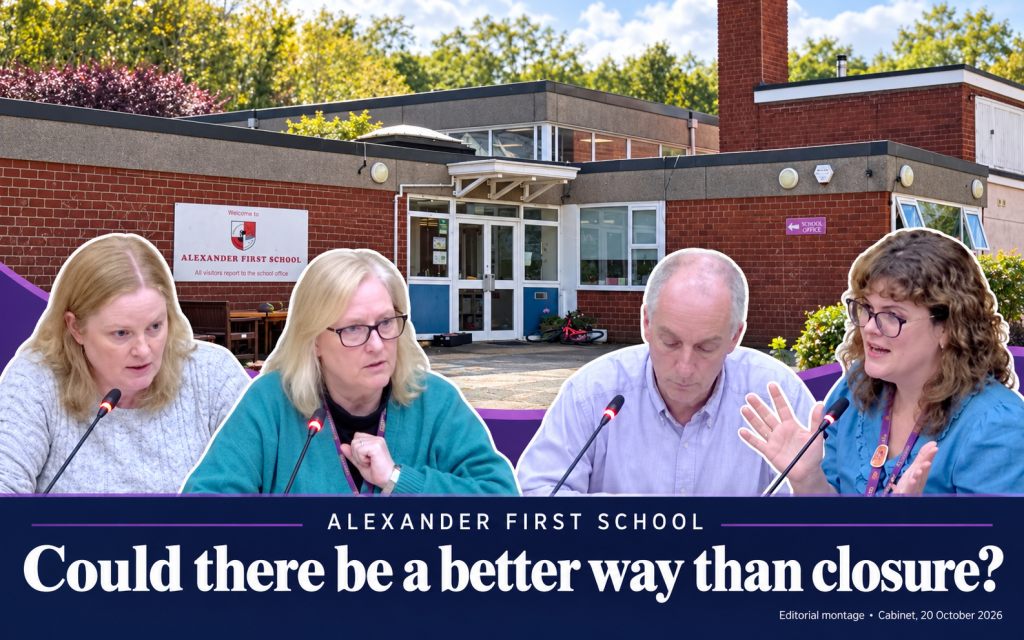
A fair decision for children, families and Windsor—and how you can help.
By Cllrs Carole and Wisdom Da Costa
Alexander First School faces closure. We believe Windsor deserves a stronger, more transparent case before a school serving children, military families and pupils with additional needs is lost.
On 20 October, RBWM’s Liberal Democrat Cabinet agreed to consult on closing Alexander at the end of the 2027/28 academic year. Final closure has not been approved. Residents still have an opportunity to influence what happens.
But language used during the process has left us concerned that closure is being treated as the expected destination. We are challenging that approach. The Council must show that evidence can change its recommendation, including in favour of keeping Alexander open.
Our question to Cabinet is straightforward: what evidence or consultation findings would cause you to retain Alexander First School, and how will those possibilities be evaluated? Residents deserve a clear answer, access to the information needed to make their case, and a published explanation of how alternatives are assessed.
Windsor’s service families deserve to be heard
Windsor knows the Guards through the uniforms, music and ceremonies that are part of our town’s identity. Behind that service are families trying to give their children stability while managing postings, separation and deployment.
The Council’s report records that 61 of Alexander’s 103 main-school pupils in January 2026 were service children. The school also serves civilian families. Eighteen pupils had Education, Health and Care Plans—EHCPs—and the school describes supporting further children while assessments or funding remain incomplete.[1]
A serving parent, speaking personally at Cabinet, raised concerns about the strain on service families when they fear their children’s educational needs will not be met. That concern deserves a considered response from both education and defence authorities.
The MOD’s own Families Strategy connects family support with retention and operational effectiveness. We want the relevant authorities to examine those implications here.[2]
Is Alexander the right choice—and can we check the evidence?
We recognise the financial pressures. If reliable forecasts establish that Windsor needs fewer first-school places, the Council must identify the fairest, most suitable way to make that change.
An overall reduction does not automatically mean Alexander should close. Nor should protecting Alexander mean simply transferring an untested threat to another school community. Every option deserves consistent scrutiny.
We are pressing five questions.
Have future children been counted? Hundreds of homes are being built or occupied around west Windsor. We have also been advised that the Welsh Guards are expected to return in July 2028, coinciding with the proposed closure. The timetable, accompanying families and implications for demand need authoritative confirmation.
Does the financial comparison tell the whole story? Published totals do not let residents check each income stream, cost and assumption. Table D5 shows the highest stated General Fund cost in 2028/29 for closing Alexander, while Table D4 shows some other options producing larger reductions in projected school deficits by 2033/34. These are different measures and need a clear reconciliation. We have asked how those figures reconcile with its favourable financial score.[1]
Does the assessment capture what children gain? Headline attainment and attendance need to be considered alongside starting points, time at the school, disrupted education and additional needs. Appendix B’s SEND assessment excludes children without EHCPs. We want to understand how their needs and the consequences for them have been assessed elsewhere.[1]
Has keeping Alexander open been properly tested? Parents describe children accessing mainstream education through individual support and flexible provision. Could that practice underpin a smaller mainstream school with formally commissioned specialist SEND provision? National inclusion-bases guidance provides a framework for assessing it. Staffing, demand, premises and recurring funding still need proper examination.[3]
Who protects the school while the outcome remains open? The Council’s own risk table assesses substantial pupil departures following announcement as a major, very likely risk even after mitigation. Families need a credible stability plan.[1]
Consultation must give people a fair opportunity
The Cabinet report proposes consultation from 2 November to 11 December. We will publish confirmed arrangements and any changes.
Families have different school calendars, including two-week half-terms, while preparation falls around holidays and responses must be made during busy pre-Christmas weeks. Schools also need time to examine data and develop credible alternatives.
The practical question is whether people have enough usable time and information to respond meaningfully.
We want clear information delivered directly to affected households, paper copies and help for people who need it. Residents should not have to discover a school’s proposed closure through social media. If important evidence arrives late, people need an appropriate further opportunity to consider it.
Consultation should invite challenges to the assumptions and workable retention proposals. Questions about moving children must not be treated as agreement that the school should close.
What we are doing—and how you can join us
Carole and I have met school leadership, listened to families and requested detailed evidence. We are coordinating with Cllrs Jack Douglas, Neil Knowles and Genevieve Gosling across political groups, while each retains their own judgement.
We are preparing to seek formal scrutiny of the decision, proposing a Full Council debate before any final closure decision, and seeking wider engagement from our MP and the relevant defence and education authorities.
Our cross-party group plans to work with the school on an independent guide to help residents understand the proposal and make their own consultation responses.
You can help now:
- Join the campaign Facebook group: LINK TO FOLLOW. Follow updates, share this article and find ways to help the school community make its case.
- Write to the Council Leader, Simon Werner, and Lead Member, Amy Tisi. Explain your own concerns and ask for verifiable evidence, a costed retention option and a fair comparison across Windsor. Their council addresses are cllr.werner@rbwm.gov.uk and cllr.tisi@rbwm.gov.uk.
- Make your own consultation response when it opens. A Facebook comment or shared article does not replace a formal response. We will share the official link and our guide.
- Help neighbours take part. Contact us if you can help distribute information, support responses or organise community participation. Keep sensitive information about children out of public comments.
- Stay involved and share this article. We will publish updates and details of any agreed public gathering in support of the school and a fair decision.
Alexander’s future should be decided through evidence, with families able to influence the outcome. Join us in making the case for keeping it open—and requiring that case to be properly tested.
Sources
[1] RBWM Cabinet report pack, 20 October 2026, including the school profile, financial tables and risk register; and Appendix B supplied separately by the Council, particularly its SEND methodology and treatment of alternatives. The January 2026 pupil figures are historical, not a statement of the current roll.
[2] UK Armed Forces Families Strategy 2022–2032.
[3] DfE: Inclusion bases in schools, June 2026. This guidance supports assessment of an option; it does not establish Alexander’s financial viability or guarantee funding.
Image: Becca Scott (Language Therapist); Cllr Carole Da Costa (Clewer & Dedworth West); Cllr Simon Werner (LibDem Leader of the Councillor); Cllr Amy Tisi (LibDem, Cabinet Member for Children’s Services, Education & Windsor)

