DRAFT ARTICLE AWAITING FINALISATION
The risks to our homes, health and livelihoods are growing. Forecasters warn that the chances of a warmer, wetter autumn are now around 1½ to 2 times higher than usual, bringing an increased risk of heavy rain, storms and flooding. Early 2027 could bring severe cold snaps, while increasingly intense summer heatwaves and the continuing threat of drought create further dangers. These are not distant possibilities: they could mean flooded homes, damaged roofs, burst pipes, water shortages, soaring household costs, power cuts and disruption to food, medicines and essential services. [1–4]
And we have already seen just how deadly extreme weather can be.
England came within just 108 deaths of its previous annual heat-mortality record during May and June 2026 alone — before July’s prolonged heatwave was even counted. The final death toll may substantially exceed that record. [5]
Nor is this a danger only to older people or those with existing illnesses. Healthy adults can also suffer serious heat exhaustion or life-threatening heatstroke. Prolonged exposure to dangerous temperatures, particularly when working or exercising, can overwhelm the body’s ability to cool itself. [6]
Imagine your home flooding, your electricity failing for three days, your heating or refrigeration stopping, or your drinking-water supply being interrupted. Could your family cope? Would your insurance cover the damage? Could you get medicines, food or help if roads were blocked and communications failed?
These are credible risks that the Government, Met Office and emergency preparedness organisations are urging us to take seriously.
The powerful El Niño developing in the Pacific adds to the uncertainty. It may increase the likelihood of particular weather patterns, although nobody can reliably predict which streets or properties will be affected or exactly when.
This is not about predicting disaster. It is about recognising the risks early enough to protect our families, homes, businesses and communities.
That is why we are asking whether Windsor and Maidenhead is sufficiently prepared — and why we believe residents should begin making practical preparations now.
A summer that may have broken the record
The UK Health Security Agency’s provisional estimate was 2,877 heat-associated deaths in England during May and June 2026 alone. [5]
The previous highest annual estimate in its monitoring series was 2,985 deaths during the whole summer of 2022.
That means England came within just 108 deaths of the previous annual record before July’s prolonged heatwave was included.
The 2026 figure was provisional. The final estimate, expected in 2027, may be substantially higher. We may therefore be looking at the highest heat-associated death toll recorded in England under the current monitoring system, although that has not yet been confirmed.
These are estimates of deaths associated with periods of extreme heat, not a count of death certificates listing heatstroke as the cause.
Nevertheless, the scale is deeply concerning.
Behind the statistics are people: parents, grandparents, friends and neighbours. People who may have been living in overheated homes, working outdoors, managing illness or simply unable to find somewhere cool.
We cannot say how many people died in association with the heat in Windsor and Maidenhead during 2026. A reliable local estimate is not available.
But the absence of a local death toll does not mean the absence of local risk.
In a briefing on 19 October, Professor Sara Blackmore highlighted evidence of elevated heat vulnerability in parts of Clewer, Dedworth and central Maidenhead. The information also referred to an estimate of 64 heat-associated deaths across the wider Thames Valley during summer 2025. That was not a figure for RBWM alone, nor for 2026. [7]
The message is clear: extreme weather is not simply an environmental issue. It is a matter of public health, safety and whether essential services can continue to function.
What might El Niño bring?
El Niño is a natural climate pattern involving unusually warm waters in the tropical Pacific. It can influence weather patterns around the world, affecting rainfall, droughts, storms and temperatures. [2]
Forecasters have been warning about the development of a particularly powerful El Niño in 2026.
That does not mean we can predict exactly what will happen in Windsor or Maidenhead. Its effects on British weather are complex, and no individual storm, flood, heatwave or cold spell can automatically be attributed to El Niño.
Nevertheless, the possibility of changing weather patterns deserves serious attention.
Depending on how atmospheric conditions develop, the coming seasons could bring periods of heavy rainfall, storms or unusual winter weather. Looking further ahead, another severe summer would bring renewed risks from extreme heat.
Internationally, droughts and floods can damage crops and disrupt food production. That can affect food prices and household budgets far beyond the countries directly affected.
History provides a sobering reminder. The exceptionally severe El Niño of 1877–78 coincided with devastating droughts and famines across several parts of the world. Millions died, although the scale of the catastrophe also reflected poverty, political decisions and failures of governance. [8]
We have far better forecasting, infrastructure and emergency services today.
The lesson is not that history will repeat itself.
It is that early warning is valuable only when it leads to preparation.
The risks do not stop at the weather
Consider what might happen if serious flooding coincided with a prolonged power cut.
Homes could lose heating, lighting, refrigeration and internet access. Mobile networks might be disrupted. Roads could become impassable, making it difficult for carers, emergency services and delivery vehicles to reach people.
A disruption to electronic payments could prevent residents from buying food or fuel even if shops remained open.
Interruptions to drinking-water supplies, sewage systems or medicine deliveries could create further problems.
And people who rely on electrically powered medical equipment, regular medication or home care could face particular difficulties.
These are not necessarily separate emergencies. One failure can trigger another.
The Government’s own emergency-preparedness advice encourages households to consider the consequences of power cuts, flooding, severe weather and other disruptions, and to keep essential supplies and important information available. [9]
This is why we should think about preparedness in terms of whole households and whole communities, not just the weather forecast.
The Government is taking the risks seriously. Are we?
The Government has recently placed greater emphasis on national resilience, including the potential for disruption to essential services, supply chains and communications.
In October 2026, it announced a new Flood and Drought Resilience Taskforce to examine how the country can prepare for increasingly severe and unpredictable conditions. [10]
National flood-risk assessments have identified millions of properties in England exposed to flooding, and the Government has announced substantial investment in flood protection.
Separately, a BBC report on 22 October described a new national resilience campaign encouraging households and businesses to prepare for disruptions caused by natural disasters, cyber incidents and failures affecting everyday services. The report highlighted the importance of being able to manage for around 72 hours, including having food, water, a torch and a radio. [11]
The risks discussed included electronic-payment failures, interruptions to water and sewage services, telecommunications problems and disruption to food supplies.
This is not a suggestion that every household should expect all these failures to happen.
It is an acknowledgement that emergencies can have consequences beyond the original event — and that sensible preparations can reduce the harm.
Government investment and national guidance are welcome.
But neither automatically establishes that Windsor and Maidenhead has the local arrangements, resources or protections it needs.
What have we asked RBWM to do?
We have been pressing the Royal Borough of Windsor and Maidenhead Council to examine its preparedness for extreme heat, drought, storms, flooding and events that exceed the assumptions used when existing infrastructure and flood defences were designed.
Our concern is broader than whether the Council possesses emergency plans.
We want to understand how well the Borough could cope with severe events affecting residents, homes, businesses, schools, roads, utilities and other critical services — especially when several problems happen together.
The Council’s initial response referred to existing strategies and arrangements, including its Environment and Climate Strategy, planning guidance, flood-risk work and multi-agency emergency planning. [12]
These are relevant and important. We are not suggesting that officers or emergency responders are doing nothing.
But having a plan is not the same as demonstrating that the plan is adequate for the circumstances we may face.
We subsequently asked for a more systematic, cross-Council approach: identifying vulnerabilities, examining dependencies between essential services, testing realistic emergency scenarios and establishing what improvements are needed.
Council Leader Cllr Simon Werner acknowledged that the scale of the climate crisis requires the Council to think differently. He confirmed that officers were planning work on climate resilience and said our points would be shared with them.
We welcome that response.
However, the Leader could not commit to what the work would include because its scope had yet to be developed. [12]
That leaves important questions unanswered.
What will be assessed? Who will be responsible? When will the work be completed? How will weaknesses be addressed? And how will councillors and residents know whether preparedness has improved?
What should a proper resilience assessment examine?
We believe RBWM should begin by establishing what already exists: the relevant risk assessments, emergency plans, service-continuity arrangements, exercises, responsibilities and recommendations from previous incidents.
The next step should be to assess whether those arrangements are sufficient.
That means considering extreme and overlapping events, including circumstances beyond the assumptions built into current plans and infrastructure.
For example, how well could the Borough cope if serious flooding coincided with a prolonged power cut, disrupted mobile networks and difficulties obtaining food or medicines?
How would vulnerable residents be identified and supported?
What arrangements would help people who depend on electrically powered medical equipment, home care, accessible transport or regular medication?
How resilient are roads, schools, care services, housing, communications, water, energy supplies and other essential infrastructure?
And how would the Council and its partners maintain their own essential services while responding to the emergency?
This is not about inventing implausible worst-case scenarios.
It is about examining credible risks, understanding how failures might interact, and testing whether existing arrangements would work.
The assessment should lead to a prioritised, costed programme of improvements, with named responsibilities, realistic timescales and progress reports.
Not every operational detail can be published, particularly where doing so would create security risks. But the Council should be able to explain publicly what it is assessing, what it has found and how it intends to improve.
What will we do next?
We intend to seek discussions with Professor Sara Blackmore, RBWM’s emergency planning team and other relevant specialists to understand the work already underway and the evidence about local vulnerabilities.
We will ask the Council to undertake a systematic review of its preparedness, beginning with an audit of existing arrangements and followed by an assessment of whether they are adequate for increasingly severe and potentially overlapping emergencies.
We will also seek clear responsibilities, measurable improvements, realistic timescales and regular public reporting.
Councillor scrutiny should be involved early enough to help shape the questions and examine the evidence, rather than being presented with conclusions after the work is largely complete.
We want to work constructively with officers, emergency services and other partners.
But constructive cooperation should go hand in hand with transparency and accountability.
The real test is not whether the Council has emergency plans. It is whether those plans are sufficiently robust, have been tested, and will protect people when they are needed.
How can you help?
Residents can play an important part in encouraging the Council to strengthen its preparedness.
You can write to your ward councillors and the Council Leader and ask:
- Has RBWM assessed how the Borough would cope if several emergencies happened at once?
- How does it identify and support residents who are especially vulnerable?
- Have emergency plans been tested against prolonged failures of electricity, water, communications or transport?
- Will the Council publish the scope and timetable of its resilience review?
- How will residents and community organisations be involved, and how will progress be reported?
You can also share concerns from your own neighbourhood: recurring flooding, homes that become dangerously hot, problems with drainage, isolated neighbours or local infrastructure that seems particularly vulnerable.
Such information can help identify problems that may not be apparent from Borough-wide reports.
And we need not wait for every answer before taking sensible precautions ourselves.
Coming next: Weather Together
In our next article, “Weather Together: How to Protect Your Family, Home and Neighbours,” we will explain how households can prepare for extreme weather and other emergencies, including disruptions to electricity, water, communications, food supplies and everyday services.
We will introduce free emergency guides, household plans and checklists that we are developing as working drafts.
These include a fridge emergency guide, a household preparedness guide, a four-bag checklist and a household emergency plan.
We intend to invite RBWM’s Emergency Planning officers and other relevant specialists to help us review and improve these resources. They have not yet been reviewed or endorsed by the Council.
Our aim is simple: Looking out for each other, whatever the weather.
We cannot prevent every emergency. But we can improve our ability to cope.
Preparedness is not measured by the number of strategies a council publishes. It is measured by how well people, homes, businesses and essential services are protected when extreme weather arrives.
Cllrs Wisdom & Carole Da Costa
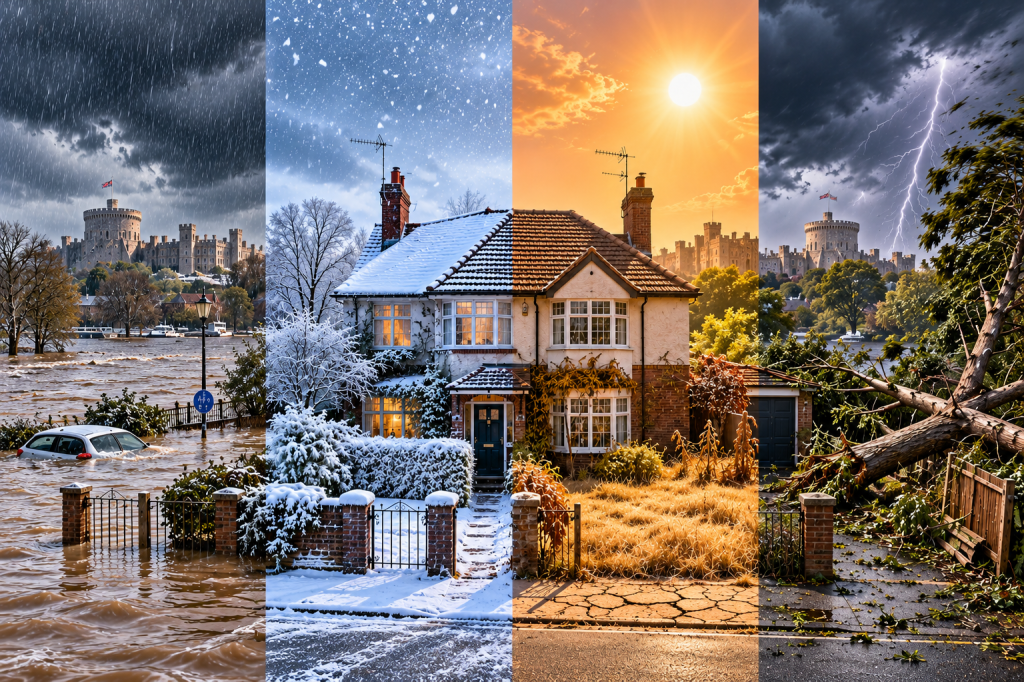
Illustration:
How extreme weather could affect homes in Windsor. The scenes are illustrative, not forecasts of specific events or locations.
References and further reading
[1] Met Office — Autumn 2026 seasonal outlook. Discussion of the increased likelihood of warmer, wetter conditions and the possible role of El Niño.
https://www.metoffice.gov.uk/blog/2026/what-does-the-latest-long-range-forecast-tell-us-and-what-role-could-el-nino-play-this-autumn
[2] Government Office for Science — Impacts of El Niño on the UK. Discussion of possible heavy rainfall, storms, flooding and cold spells, together with forecast uncertainties.
https://www.gov.uk/government/publications/impacts-of-el-nino-on-the-uk/impacts-of-el-nino-on-the-uk
[3] UK Health Security Agency — Climate change and adverse weather in UK summers. Discussion of changing summer risks, including heatwaves.
https://ukhsa.blog.gov.uk/2026/07/10/what-is-the-impact-of-climate-change-and-adverse-weather-on-summers-in-the-uk/
[4] UK Government — Flood and drought resilience, October 2026. Government statement concerning flood and drought preparedness.
https://questions-statements.parliament.uk/written-statements/detail/2026-10-13/hlws378
[5] UK Health Security Agency — Interim heat mortality monitoring report, England: May and June 2026. Source for the provisional 2,877 heat-associated deaths and the comparison with the 2022 annual estimate of 2,985.
https://www.gov.uk/government/publications/interim-heat-mortality-monitoring-report-england-may-and-june-2026/interim-heat-mortality-monitoring-report-england-may-and-june-2026
[6] UK Health Security Agency — Beat the Heat: Staying safe in hot weather. Official guidance on heat exhaustion, heatstroke and precautions.
https://www.gov.uk/government/publications/beat-the-heat-resources-for-hot-weather/beat-the-heat-staying-safe-in-hot-weather
[7] Professor Sara Blackmore — Briefing, 19 October 2026. Information on local heat vulnerability and the separate 2025 Thames Valley heat-associated mortality estimate. Public link to be added if available.
[8] Historical research on the 1877–78 El Niño and associated famines. Full research citation to be confirmed before final publication.
[9] UK Government — Prepare: Get prepared for emergencies. Practical guidance on household emergency plans, supplies and disruptions.
https://prepare.campaign.gov.uk/get-prepared-for-emergencies/
[10] Department for Environment, Food & Rural Affairs — New taskforce to boost Britain’s resilience to flooding and drought, October 2026.
https://www.gov.uk/government/news/new-taskforce-to-boost-britains-resilience-to-flooding-and-drought
[11] BBC News, 22 October 2026 — Tara Mewawalla, “Prepare for supply chain disruption from cyber or climate emergencies, Streeting warns.”
https://www.bbc.co.uk/news/articles/cwd094x57p32o
[12] RBWM Full Council correspondence — Climate resilience question and subsequent response from Council Leader Cllr Simon Werner. Council meeting record and correspondence links to be added if publicly available.


Response
[…] our first article, “After the Deadly Summer, Are We Ready for What El Niño Could Bring?”, we examined the growing risks from extreme heat, flooding, storms, drought and freezing […]
LikeLike