By Cllrs Carole and Wisdom Da Costa
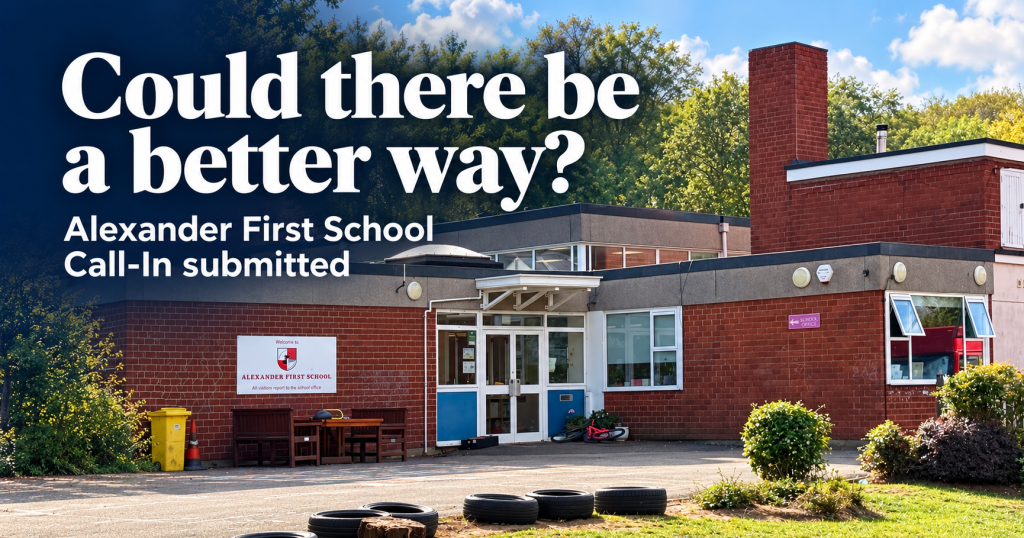
We have submitted a formal Call-In challenging Cabinet’s decision to consult on closing Alexander First School. We want scrutiny of the evidence, the consequences for children and families, and realistic ways of keeping the school open.
Working with fellow councillors, school leaders, professionals and service families—including senior staff during their holiday week—we have identified concerns about:
- The finances: how the scores and recommendation fit with Alexander’s higher projected closure implementation cost.
- The selection process: insufficiently explained weightings, unpublished calculations and information provided too late for proper examination.
- Children and alternatives: support for pupils with additional needs and service families, the school’s existing inclusion provision, and proposals to develop it while remaining open.
- Immediate risks: protecting staffing and children’s education if families leave during consultation.
Latest position—28 October: Democratic Services has acknowledged receipt of the Call-In. Following submission of the final version, it confirmed that Cllr Neil Knowles remains the third signatory and that the form has been reviewed and referred to relevant officers for discussion of its validity. The Council has said it will either accept the Call-In or give reasons for rejecting it. Acceptance and any scrutiny hearing date have not yet been confirmed. We will update residents as soon as we receive the decision.
The next step in our work for Alexander
In our earlier articles, Alexander First School: children first, evidence before closure and Alexander First School: could there be a better way than closure?, we raised questions about Alexander’s future. The Call-In is the next step in that work.
On 20 October, RBWM’s Liberal Democrat Cabinet approved consultation on closing Alexander. That was not a final closure decision. However, selecting the school for closure consultation is itself significant, with potential consequences for families, staffing and confidence in its future.
A Call-In is a formal request for scrutiny of a decision. Ours asks whether Cabinet had sufficiently reliable information, a clear explanation of the comparison between schools, and an adequate assessment of alternatives and impacts before proceeding.
Click here to read a copy of our Call In
A collaborative effort for Alexander
The submission follows detailed examination of the Council’s papers, questions to officers and discussions with the school team, professionals and service families.
We are particularly grateful to senior school staff who have continued working with us during their holiday week. Their knowledge of the children, the school’s provision and its potential has been invaluable.
Cllr Jack Douglas has put substantial work into examining the evidence and coordinating preparation of the Call-In with us. Carole has submitted it as a member of the scrutiny Panel, supported by Wisdom as a ward councillor and Cllr Neil Knowles, the Borough’s Armed Forces Champion.
We also welcome Cllr Genevieve Gosling’s support for the challenge. Concern for Alexander and the quality of this decision crosses political groups.
Alexander serves both civilian and service families. We have been told that families at Broom Farm include personnel serving across several Army units and the RAF. For children experiencing postings, parental absence or additional needs, the support and relationships built within a school deserve careful consideration.
What are we asking the Council to explain?
The Call-In raises three connected concerns: the financial comparison, the transparency of the selection process, and the assessment of children’s needs and alternatives to closure. These lead to five practical questions.
Do the financial figures support choosing Alexander?
The Council’s figures put Alexander’s projected closure implementation cost above the other thirteen options. Four other options would reduce the projected overall school deficit by more by 2033/34.
We are asking how those figures fit with the scores and recommendation. Officers have also acknowledged an error describing reductions in accumulated deficits as annual reductions, while important school-by-school figures remain unpublished.
We are not saying the cheapest option must win. We are asking for a reliable comparison and a clear explanation of the financial trade-offs.
Can the selection process be checked?
The ranking depends on the factors chosen and how much importance each receives. Officers have explained their broad priorities, but not the evidence behind the particular percentages.
They say changing the SEND and finance weightings moves Alexander from first to second place. We want the calculations and testing needed to understand how reliable the recommendation is.
The detailed appraisal was published only the day before Cabinet, and substantive answers to our earlier questions arrived after the decision.
Have all children’s needs been adequately considered?
The appraisal’s SEND section excludes children without an Education, Health and Care Plan, although many children needing support do not have one.
The papers describe service families’ circumstances, but do not clearly explain how the Armed Forces Covenant principles shaped the recommendation.
We want the assessment to account properly for the children affected and the support they need, including the consequences of disruption during consultation.
Have realistic ways of retaining Alexander received proper examination?
Alexander already operates two inclusion bases. Its headteacher submitted proposals to develop provision, with indicative cost comparisons, months before Cabinet. The papers do not show how those proposals were assessed.
We want a consistent comparison of realistic alternatives—including retaining the mainstream school with additional SEN provision—and clear reasons where options are discounted.
Retaining a mainstream school with added specialist provision is different from closing it and converting the site to another educational use. That distinction matters when considering what could be achieved for children and families.
How will children and staff be protected during the process?
The Council itself identifies a very likely risk of substantial pupil departures once consultation is announced.
We are asking for practical arrangements to maintain staffing, support and educational continuity if that happens. Otherwise, the process could make keeping the school open harder before a final decision is taken.
These concerns do not prove that every alternative will work. They explain why we believe the Council needs a fuller, clearer basis for deciding Alexander’s future.
What we want scrutiny to achieve
We are asking for the decision to be referred back for reconsideration with the necessary evidence and explanation, including a consistent assessment of realistic alternatives.
The Panel should be able to examine what was known, what remains uncertain and whether the reasons for selecting Alexander stand up to scrutiny.
We have requested a hearing close to 11 November, within the applicable timetable, allowing time to prepare and consider the officers’ outstanding answer on adding SEN provision to a continuing mainstream school, expected on 6 November. The date has not yet been confirmed.
What next?
Our immediate next step is to obtain confirmation of whether the Call-In has been accepted. If it is accepted, we will share the scrutiny hearing arrangements and any opportunities for public participation. If it is rejected, we will explain the reasons given and consider the next steps.
Our next update, Alexander First School: the Call-In outcome and what happens next, will explain the outcome, any further evidence or action requested, and what it means for the school, children, families and staff.
The consultation has not yet opened. If it proceeds, we will publish Alexander First School consultation: understanding the proposals and having your say. This will explain the proposals, how and when to respond, meeting arrangements, and the evidence and alternatives residents may wish to consider.
We have already been helping the school consider arrangements for parent and staff meetings: information in advance, appropriate officers available to answer questions, accessible participation and a clear record of responses.
At Cabinet, Cllrs Amy Tisi and Simon Werner invited people to challenge the appraisal and suggest alternatives. We will seek the information and fair meeting arrangements needed to make that invitation meaningful.
We will help parents, staff and supporters respond in their own words. Families should not need to become financial analysts to explain what Alexander provides or what losing it would mean for their children. Their experiences deserve to be heard alongside the financial and professional evidence.
The full Call-In is attached below, including the evidence references and the action we are asking scrutiny to recommend.
We will continue working with the school community to secure a fair examination of Alexander’s future—and of the possibilities for keeping it open.

