Looking out for each other, whatever the weather.
DRAFT ARTICLE AWAITING FINALISATION
Could your household manage for three days if the electricity, water supply, mobile networks or local shops stopped working?
FREE DOWNLOADABLE HELP SHEETS BELOW
It is not something most of us spend much time thinking about. We turn on the tap, switch on the lights, use our phones, buy food when we need it and assume that essential services will be there tomorrow.
Usually, they are. But severe weather can change that surprisingly quickly.
In our first article, “After the Deadly Summer, Are We Ready for What El Niño Could Bring?”, we examined the growing risks from extreme heat, flooding, storms, drought and freezing weather, and asked whether Windsor and Maidenhead are sufficiently prepared.
We also explained why the consequences can reach far beyond the weather itself. A storm might cause a power cut. That could interrupt communications, payment systems, heating, refrigeration or water supplies. Flooding might prevent people reaching shops, pharmacies or medical appointments.
The question is not whether every one of these things will happen. It is whether we can take some sensible precautions so that, if something does go wrong, we are better able to cope.
That is why we are launching Weather Together — a practical, community-focused initiative to help households prepare for emergencies and look out for one another.
Our message is simple: a little preparation now could make a very big difference later.
Could your household manage for three days?
The UK Government’s Prepare campaign encourages households to think ahead about emergencies, including disruptions to electricity, water and communications, and to keep essential supplies available. [1]
Imagine that a severe storm leaves your neighbourhood without electricity for three days.
Your fridge and freezer stop working. Your broadband router is down. Your mobile phone battery is running low. The nearest supermarket cannot accept card payments, and local roads may be blocked by fallen trees.
Or imagine that flooding interrupts your water supply and prevents you from leaving home.
Would you have enough to drink and eat? Could you stay warm? Would you know how to receive reliable information? Could you contact relatives or neighbours?
These are not reasons to panic. They are reasons to prepare.
A useful starting point is to consider how your household could manage for at least 72 hours with limited access to normal services.
Three days is a planning starting point, not a guarantee that every emergency will be over within that time. Some households may need to prepare for longer, particularly where medical needs, isolation or other vulnerabilities make interruptions more serious.
What should you actually keep at home — and how much?
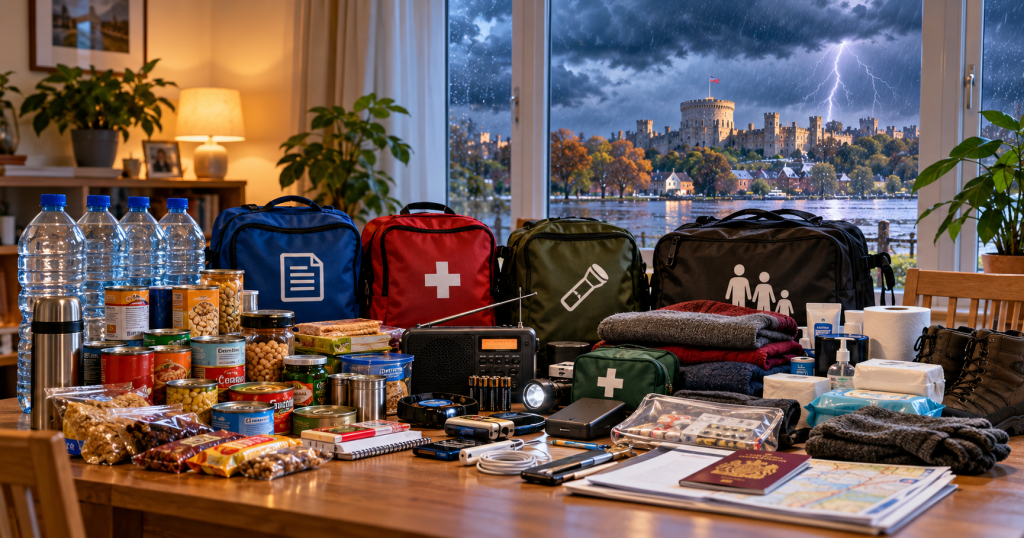
Having drinking water, food that does not require cooking, torches, a radio, batteries, warm clothing and essential personal supplies could make those first few days considerably easier.
But how much water does a family actually need? What food should you keep? How many torches, batteries and other essentials are sensible?
To help answer those questions, we have produced a free, printable guide:
What Should You Actually Keep at Home — and How Much? (PDF)
It includes recommended water quantities for different household sizes, examples of food that can be stored and eaten without cooking, practical equipment suggestions, and a checklist to help you work out what you already have and what you might still need.
For example, the UK Government recommends allowing at least 2.5–3 litres of drinking water per person per day. A more comfortable allowance of 10 litres per person per day also helps cover basic cooking and hygiene. [1]
That means a household of four would need approximately 36 litres of drinking water for three days, or up to 120 litres for the more comfortable allowance.
The guide draws on UK Government emergency preparedness advice and distinguishes official recommendations from our own practical suggestions.
You do not need to buy everything at once. Start with what you already have, add a few essentials during your normal shopping, and gradually build up your household supplies.
Remember: supplies kept at home are different from the smaller emergency bags you might need if you have to leave quickly.
Stay at home or leave? Know the difference
Different emergencies call for different responses.
During a power cut or some periods of severe weather, remaining safely at home may be the best option.
During serious flooding, a fire or another immediate danger, you may need to evacuate.
The important thing is to think about both possibilities in advance.
If you are advised to stay at home, you may need drinking water, ready-to-eat food, lighting, warmth, medication, hygiene supplies and a reliable way of receiving information.
If you need to leave quickly, you will not want to be searching through cupboards for passports, medicines, phone chargers or important telephone numbers.
That is why we suggest keeping your emergency preparations in two parts:
First, your household emergency store: the food, water and equipment that can help you manage at home.
Second, your emergency bags: a smaller, organised collection of important items that you can take with you if you must leave.
Always follow official emergency instructions. Never remain in a dangerous property simply because you have prepared supplies.
Four bags that could make an emergency easier
We suggest a simple four-bag system to help organise the things you might need if you have to leave home.
Not every household will need four separate physical bags. The principle is to keep essential items organised, accessible and easy to collect.
Bag 1: Important documents
A waterproof document pouch could contain important original documents, where appropriate, or copies of them.
These might include passports, birth and marriage certificates, insurance information, property documents, driving licences, essential legal documents and important education or professional certificates.
Keep a written list of emergency contacts and relevant account or policy contact details.
Sensitive documents should be stored securely and protected from theft or unauthorised access. Digital backups can be useful, provided they are securely protected and accessible when needed.
Bag 2: Medicines and personal care
This bag covers the items that individuals cannot easily manage without.
Depending on your household, these may include essential medication, prescription information, glasses, hearing-aid batteries, personal hygiene products, sanitary supplies, continence products and essential medical equipment.
Medicines should always be stored in accordance with their instructions. Some may need refrigeration or particular security arrangements and should not simply be left permanently in a bag.
A checklist beside the bag can identify medicines or equipment that must be collected immediately before leaving.
Bag 3: Portable essentials
A small rucksack could contain practical items for the first few hours away from home.
These might include a torch, charged power bank, phone cable, battery-powered or wind-up radio, small first-aid kit, bottled water, ready-to-eat snacks, spare socks, a warm layer and a little cash.
Include anything particularly important for children or other household members.
The aim is to keep this bag light enough to carry comfortably.
Bag 4: Additional evacuation supplies
A larger holdall could contain extra clothing, waterproofs, sturdy footwear, toiletries, additional food, blankets and other useful items.
This bag is optional and may be particularly helpful if you expect to be away from home for longer.
It should not delay evacuation when there is immediate danger.
The important point is not the number of bags. It is knowing where everything is and being able to find it quickly.
Our downloadable Four-Bag Emergency Checklist provides a practical way to organise these supplies.
Don’t forget your household emergency plan
Equipment and supplies are valuable, but knowing what to do can be just as important.
A household emergency plan should answer some simple questions.
How will you contact one another if mobile networks fail? Where will you meet if you cannot return home? Who will collect children or help someone who needs assistance? Where are the water, gas and electricity shut-offs, and who knows how to use them safely?
What would happen to pets? Where could you stay if your home became temporarily uninhabitable?
And if you live in an area at risk of flooding, do you know how to receive flood warnings?
The Environment Agency provides a service for checking long-term flood risk and signing up for flood warnings in England. [2][3]
Our Household Emergency Plan is designed to help families record this information before it is needed.
Keep a printed copy somewhere accessible, because a plan stored only on a phone or computer may be unavailable during a power cut.
What about your car, bicycle or other transport?
Extreme weather can affect transport just as seriously as homes.
Roads may flood, fallen trees may block routes, public transport may stop operating and petrol stations may be unable to dispense fuel during electricity failures.
A modest vehicle emergency kit might include a torch, warm clothing or blanket, water, snacks, phone charging equipment, a high-visibility vest and suitable footwear.
If you use an electric vehicle, consider how you would manage during a prolonged power cut or when charging facilities are unavailable.
If you cycle regularly, think about weather protection, lighting, safe routes and whether your usual journey would remain practical during an emergency.
Keep vehicles properly maintained and avoid allowing fuel or battery charge to run unnecessarily low when severe weather is forecast.
Never drive or cycle through floodwater. Water may be deeper or faster-moving than it appears, and road surfaces may be damaged or hidden. [4]
Most importantly, do not attempt a journey simply because you have the equipment to do so. Sometimes the safest decision is not to travel.
Preparing for heat as well as cold
Emergency preparation is often associated with freezing temperatures, snow and storms. But extreme heat can be just as dangerous.
In our first article, we highlighted the serious health consequences of the exceptionally hot summer of 2026.
Preparing for heat means thinking about how to keep your home cooler, maintain access to drinking water, protect people at particular risk and recognise when someone may be developing heat exhaustion or heatstroke.
The UK Health Security Agency advises measures such as keeping out of the heat during the hottest periods, closing curtains or blinds where sunlight is heating rooms, drinking sufficient fluids and checking on people who may be particularly vulnerable. [5]
For cold weather, think about warm clothing, blankets, suitable bedding and ways to reduce heat loss if your heating stops.
Never use barbecues, charcoal burners, camping stoves or outdoor heaters inside homes or garages. They can produce deadly carbon monoxide.
The aim is to prepare for different kinds of extreme weather, rather than assuming that the next emergency will resemble the last one.
Looking out for our neighbours
Being prepared is not just about what we keep in our cupboards.
It is also about knowing who might need help.
An older neighbour living alone, a family with a newborn baby, someone dependent on medical equipment, or a resident with limited mobility could face particular difficulties during a prolonged power cut, flood or heatwave.
Sometimes the most valuable preparation is knowing who to telephone, who might need checking on, and who could offer practical help.
A friendly conversation before an emergency can make a real difference.
Would your neighbour appreciate a telephone call during severe weather? Does someone nearby need help receiving official warnings? Could you help collect essential supplies if roads and shops remain accessible and it is safe to do so?
We should also remember that not everyone can afford to keep large quantities of food and water or buy additional equipment.
Preparedness should be practical and inclusive, not another financial burden imposed on households already struggling with everyday costs.
Of course, no one should put themselves in danger. During an emergency, follow official warnings and instructions, and call the emergency services where necessary.
But strong communities can make an enormous difference, particularly in the hours before outside help is available.
That is what Weather Together is intended to encourage.
Five free guides to help you get started
We have prepared five printable Weather Together guides to help residents turn advice into practical action – click each title to download the content
- A5 Fridge Emergency Guide — a quick-reference sheet with essential information to keep somewhere visible.
- Household Preparedness Guide — practical advice on preparing your home, family and essential supplies.
- Four-Bag Emergency Checklist — a simple way of organising important documents, medication, portable essentials and additional evacuation supplies.
- Household Emergency Plan — a form to record important contacts, medical needs, meeting arrangements and what to do if you cannot remain at home.
- What Should You Actually Keep at Home — and How Much? — specific quantities of water, food and other essential supplies, with references and a household checklist.
Download all five Weather Together guides — combined PDF
These are working drafts. We intend to ask RBWM’s Emergency Planning officers to review and help improve them before presenting them as final public guidance. They have not yet been endorsed by the Council.
We would also welcome practical suggestions from residents, particularly those with experience of flooding, extended power cuts, caring responsibilities or other emergencies.
Our aim is to make preparing for emergencies as straightforward and affordable as possible.
Coming next: Making Windsor and Maidenhead More Resilient
Preparing our households is important. But it cannot replace the responsibilities of public authorities, utilities and organisations providing essential services.
In our first article, we asked whether the Borough is sufficiently prepared for extreme weather and the cascading problems that can follow.
In this second article, we have focused on practical steps that residents can take themselves.
In Article 3, “Making Windsor and Maidenhead More Resilient”, we will return to the bigger question: how well prepared is the Borough itself?
We will examine what a proper assessment of local resilience should involve, including the Council’s emergency plans, risks to essential services, support for vulnerable residents, and how well different organisations could work together during a prolonged or complex emergency.
We will also consider how residents and councillors can help ensure that preparedness leads to practical improvements, rather than simply more plans and strategies.
We believe household preparedness and institutional preparedness must go hand in hand.
We cannot prevent every storm, flood, heatwave or emergency. But we can work together to reduce the harm they cause.
Weather Together — Looking out for each other, whatever the weather.
Cllrs Wisdom & Carole Da Costa
References and further information
[1] UK Government — Prepare: Get prepared for emergencies. Guidance on emergency supplies, household plans, water, food, communications and power cuts.
https://prepare.campaign.gov.uk/get-prepared-for-emergencies/
[2] GOV.UK — Check the long-term flood risk for an area in England.
https://www.gov.uk/check-long-term-flood-risk
[3] GOV.UK — Sign up for flood warnings.
https://www.gov.uk/sign-up-for-flood-warnings
[4] The Highway Code — Rule 227: Driving in wet weather. Guidance on avoiding dangerous water conditions on roads.
https://www.gov.uk/guidance/the-highway-code/driving-in-adverse-weather-conditions-226-to-237
[5] UK Health Security Agency — Beat the heat: staying safe in hot weather.
https://www.gov.uk/government/publications/beat-the-heat-resources-for-hot-weather/beat-the-heat-staying-safe-in-hot-weather
[6] UK Government — Prepare: Water supply interruptions or outages.
https://prepare.campaign.gov.uk/be-informed-about-hazards/water-supply-interruptions-or-outages/
[7] UK Government — Impacts of El Niño on the UK. Background on how El Niño may influence UK weather and the uncertainties involved.
https://www.gov.uk/government/publications/impacts-of-el-nino-on-the-uk/impacts-of-el-nino-on-the-uk
Editorial note: This is a consolidated publication draft. The detailed household supplies guide and the other Weather Together downloads remain review drafts pending technical feedback from RBWM. The reference links should receive a final check before publication.


Response
[…] our next article, “Weather Together: How to Protect Your Family, Home and Neighbours,” we will explain how households can prepare for extreme weather and other emergencies, including […]
LikeLike